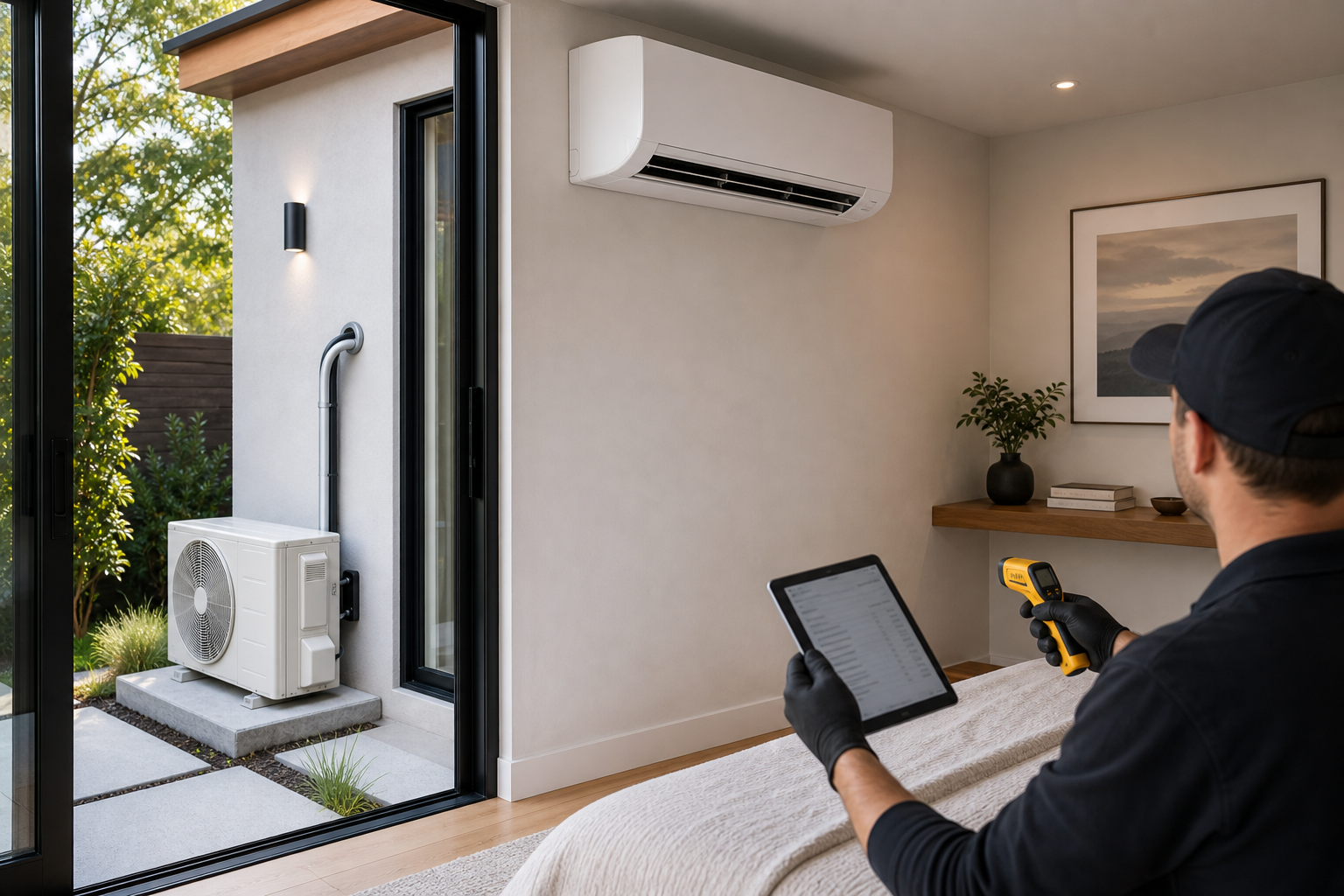
How a Mini Split Install actually gets installed in LA
Ductless work in the older Spanish and Craftsman stock from Highland Park down through Echo Park is almost always a multi-zone retrofit because there is no attic to run trunk duct and the plaster walls cannot tolerate the chase work. My standard layout for a three-bedroom 1,400 sqft bungalow is a Mitsubishi MXZ-3C30NAHZ2 outdoor feeding two MSZ-FS06NA 9,000 BTU heads in the bedrooms and one MSZ-FH12NA 12,000 BTU in the living room — that gets noise down to 19 dB on low fan and clears HSPF2 10.5 for the LADWP tier-2 rebate. When the load runs higher or the homeowner wants ducted concealment in a closet I move to a PEAD ceiling-concealed unit with a remote return, and I budget for an Aspen Mini Lime condensate pump rated for 26 ft of head when the head sits below the nearest gravity drain. Line-set length matters: every foot beyond 25 ft adds refrigerant per the Mitsubishi engineering manual, and going past 50 ft on a 1/4 by 3/8 set without sizing up the liquid line is how I diagnosed a Fujitsu Halcyon AOU24RLXFZH that was undercharged from day one on a Silver Lake hillside install. Vacuum to 500 microns, isolate, and watch for rise — anything over 1,000 microns in 15 minutes is a leak, not a wet system. SCAQMD Rule 1407 governs the refrigerant recovery if there is a legacy R-22 system on site, and Title 24 Part 6 §150.2(b) HERS verification still applies when the install crosses 1,000 sqft of conditioned floor area.
Scoping ductless mini split installation as a complete installed system, instead of as a piece of equipment with a price tag, is what separates the proposals that age well from the ones that produce callbacks. The installed result tracks zone load, line-set route, condensate route, vacuum record, sound placement. Cali HVAC writes those checkpoints into a closeout file the homeowner can keep, so the project stops being defined by the box on the truck and starts being defined by the verifications around it.
A ductless mini split installation project that ignores head location chosen for convenience, visible line sets, condensate pumps added without service access is borrowing comfort from another house. Across LA's older ducts, compact lots, rooftop installations, hillside refrigerant routes, ADUs, condos, and premium remodels, those failure modes are the working baseline. The page exists for homeowners who would rather have those risks named in advance than discovered during a callback in August.
Concretely, the homeowner walks away with zone map, line-set route photos, startup checklist, remote and app handoff. The package is rounded out with photos, model numbers, startup readings, owner training, and a written list of the caveats — permits, rebates, warranty registration, building limitations — that would otherwise live only in the installer's memory. The point is to make the install legible to someone who was not present for it.
Expected cost lands in the $4 200 to $20 500 range, with access, equipment tier, electrical work, duct or line-set changes, controls, and finish protection driving the spread. The number gets sharper after the field walk. A meaningfully cheaper bid that has also removed commissioning is a separate kind of project — one where the homeowner has no documentation to fall back on if comfort or efficiency does not match the proposal.
On the search side, the cluster that matters is ductless mini split Los Angeles ADU, whole-home ductless rebate, mini split permit LA, and bedroom heat pump installation. Those queries come from a homeowner who has already framed the decision around outcomes rather than around brands, and they are asking whether homeowners often ask about ADUs, bedrooms, garage conversions, whole-home ductless layouts, rebate eligibility, line-set visibility, and whether one head can solve the whole complaint. Earning that click means answering with measurements and documents — the same artifacts the closeout file is built around — instead of with category-level reassurance.
The expected document set is zone map, equipment match, vacuum record, condensate route photos, permit notes, and clear rebate caveats when an ADU or single-room install is involved. The expected field readings are wall placement, throw pattern, sleep position, drain slope, exterior line-set protection, condenser clearance, and 120V versus 240V electrical scope. A single-room mini split can be the right comfort answer, but many rebate programs care about whole-home service and exact eligibility rules. The reason the page lays out both is that they are the deliverables that outlast the install crew — they are what the homeowner reads when a comfort complaint surfaces, what the future technician reads at the next service visit, and what an inspector reads if the property changes hands.
How this service gets documented
Los Angeles proof points for Ductless Mini Split Installation
The ductless mini split conversation in Los Angeles works better when it begins with what the building is, not what the catalog offers. Spanish homes, apartments, ADUs, hillside additions, flat roofs, and mixed-age duct systems and marine layer mornings, valley spillover heat, smoke days, and room-by-room load swings are not abstractions on this side of the foothills; they decide whether a system runs long efficient cycles or fights the house. Cali HVAC reads those conditions first, then writes a scope that respects old ducts, tight side yards, return-air limits, panel surprises, and LADBS permit sequencing before any equipment family is named.
Site visits exist to remove guesses, not to create momentum. For a Los Angeles ductless mini split we measure vacuum record, photograph sound placement, check the LADWP and SoCalGas service entry, and write down which Central LA basin climate behaviors the new system will be answering. The file produced on that visit is the document the bid is built on; if a contractor cannot produce one, the bid is a guess wearing a price tag.
A conventional bid can hide too much behind a tonnage number. Our ductless mini split recommendation names the equipment family, the indoor and outdoor match, the route, the drainage or electrical assumptions, and the owner handoff. The closeout file is designed to make a future service technician, property manager, or homeowner understand why the system was installed the way it was. That matters in Los Angeles because citywide installs need a record that separates equipment performance from building constraints.
Searches like "Los Angeles ductless mini split" deserve a real answer, not a coupon. The honest answer in Los Angeles usually involves at least one of these risks: head location chosen for convenience, or visible line sets. The proposal should call those out instead of pretending the install is identical to a flat-lot suburban tract.
Closeout is where the ductless mini split stops being a sales conversation and becomes a documented installed system. Expect zone map, line-set route photos, startup checklist, remote and app handoff in the file, plus photos, filter dimensions, control settings, and operating notes. If the closeout for an inverter or heat pump system does not address runtime profile, the file is incomplete.
Replacement work is uniquely unforgiving. Once the old ductless mini split target is removed and the wall is closed, fixing a sizing or airflow mistake is expensive. So in Los Angeles we move slowly on the front end: load assumptions, return-air check, attic or roof access, line or duct route — all settled before the crew shows up. The reward is an install day with no surprises.