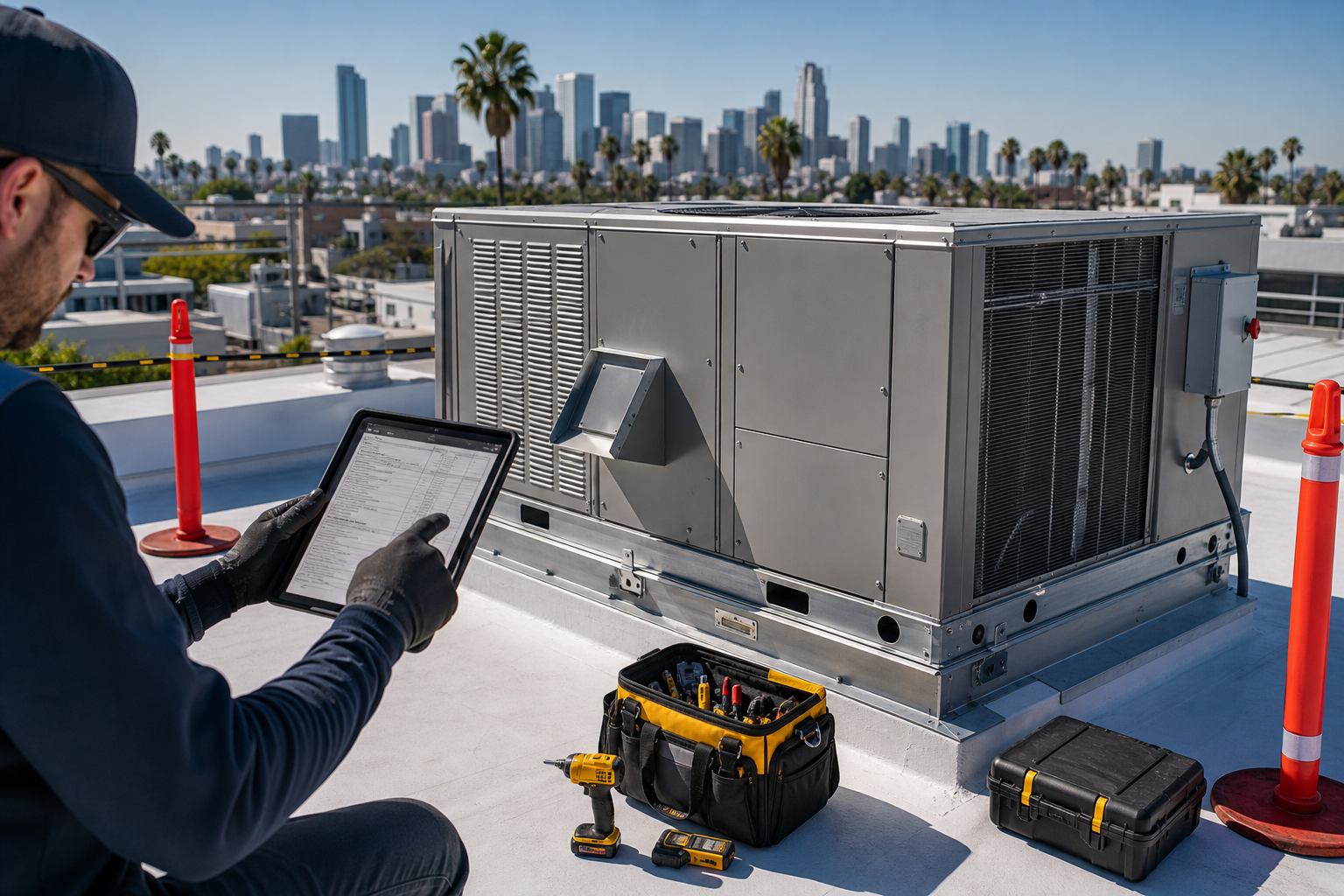
How a Rooftop Unit Replacement actually gets installed in LA
Commercial RTU swaps in the LA basin pull a different rulebook — NEC Article 440 disconnect, NEC 110.26 working clearance, structural sign-off on the curb adapter, and ASHRAE Standard 232-2024 commissioning if the building owner wants LEED or Title 24 nonresidential compliance. For a 7.5-ton replacement on 460V/3-phase serving a Glendale strip-mall tenant I default to the Carrier WeatherMaker 48TC because the curb dimensions on the existing 48HJ frame within 2 inches and a Carrier-to-Carrier adapter avoids fabricating sheet metal on the roof. When the building wants higher staging I quote the Trane Voyager Y or the Lennox Strategos with two-stage scroll, and on tight existing curbs I have used York Sunline because the footprint is shorter than the older Bryant equivalents. Crane day is the cost driver: I price a 30-ton boom truck for anything over 6 tons, and I confirm the roof live-load capacity with the building engineer before the lift because a 1980s Type V wood structure in Highland Park will not take 1,200 lbs of new equipment plus a full salt-corrosion-spec condenser fan motor without a beam reinforcement letter. AHRI 210/240 covers the matched performance certificate, refrigerant is now R-454B on most new platforms, and EPA Section 608 type II is the minimum cert for the recovery on the legacy R-410A. LADBS commercial mechanical permit, Glendale Water and Power or LADWP rebate paperwork, and SCAQMD Rule 1407 recovery documentation all go in the closeout package — I have watched a 6-month-old install fail audit because the recovery tank weight ticket was missing.
Rooftop Package Unit Replacement in Los Angeles is a system, not a SKU. The performance the homeowner actually experiences is shaped by curb fit, roof access, economizer or vent settings, startup amps, tenant notice timing — none of which appear on the equipment label. Cali HVAC treats those checkpoints as the deliverables and writes them into the project record, because a system that is not commissioned in writing is, functionally, a system without commissioning at all.
This service category exists because the box-swap version produces predictable problems. The risks — roof access promised too casually, curb adapters missed, startup values skipped after crane day — are familiar across LA's older ducts, narrow access, rooftop work, hillside runs, ADUs, condos, and high-end remodels. A consult that walks past them is selling a number; a consult that names them is selling a scope. The pages here lean on the second version.
The deliverables stack for a rooftop package unit project is intentionally practical: access plan, model and serial photos, startup sheet, tenant or HOA closeout notes, with photos, model numbers, startup readings, owner training, and the caveats around permits, rebates, warranty, and existing-building constraints written into the file. The future technician should be able to open the package and understand the system without phoning anyone, which is the working definition of a closeout that holds up.
Budget context for a rooftop package unit project usually falls in the $9 200 to $48 000 range, depending on access, equipment tier, electrical readiness, duct or line-set work, controls, and finish protection. The field walk replaces guesswork with a real number. A bid that comes in well below the range is worth examining specifically for commissioning proof — because that is the line item most often quietly removed to clear the price comparison.
The query stack for rooftop package unit is rooftop package unit replacement Los Angeles, condo heat pump rooftop unit, HVAC crane access LA, and package unit permit. Those searches share a posture: the buyer is past the slogan stage and is testing whether property owners and condo managers are comparing access, crane timing, curb adapters, tenant notices, noise, and whether package equipment can convert to heat pump operation. A page that performs against those queries has to answer in the same register the buyer is searching in — measurements, paperwork, field record — which is also the register the install is run in.
Paperwork for this scope is access plan, curb and adapter notes, serial photos, startup amps, economizer or ventilation settings, tenant notice timing, and permit closeout; field measurements are roof hatch dimensions, crane or lift staging, curb condition, service clearance, electrical disconnect, condensate path, and building-manager coordination. The hardest part is often not the new unit; it is access, fit, timing, and documenting what happened after the crane leaves. The point of writing both into the page is that the service should be tied to an artifact the homeowner can hold — a permit record, a startup report, a verification readout — rather than to a category label. That tie is also what keeps the page from drifting into thin pSEO territory.
How this service gets documented
Los Angeles proof points for Rooftop Package Unit Replacement
A rooftop package unit that looks identical in two Los Angeles bids is rarely identical in execution. The hidden variables — Spanish homes, apartments, ADUs, hillside additions, flat roofs, and mixed-age duct systems, marine layer mornings, valley spillover heat, smoke days, and room-by-room load swings, and the labor reality of old ducts, tight side yards, return-air limits, panel surprises, and LADBS permit sequencing — push the work in different directions on different houses. Cali HVAC writes those variables onto the proposal so the homeowner can see what the crew is actually solving for, instead of comparing two equipment lists that pretend the building is the same.
The first visit is built around the conditions that can make a good system disappoint. For this scope we look at curb fit, roof access, economizer or vent settings, startup amps, tenant notice timing, then connect those findings to the real building. In Los Angeles, that means the notes reference Hancock Park, Koreatown, Mid-City, utility context through LADWP and SoCalGas, and the Central LA basin climate pattern instead of a citywide sales script.
Tonnage and brand alone are a thin proposal. For Los Angeles, our rooftop package unit bid spells out the indoor-outdoor match, the line or duct route, drainage or electrical assumptions, what gets photographed, what gets measured, and what changes hands at the close. The reason that detail matters here: citywide installs need a record that separates equipment performance from building constraints.
When the long-tail query is "Los Angeles rooftop package unit", the homeowner is past brand shopping. They want to know what could go wrong. For this service in Los Angeles, the common failure points are roof access promised too casually, curb adapters missed, startup values skipped after crane day. Those risks belong in the bid, not in the post-install conversation.
The proof pack is what separates a real rooftop package unit from a paid invoice. For Los Angeles we deliver tenant or HOA closeout notes and access plan alongside model photos, filter spec, control settings, and operating notes. A future tech should be able to maintain the system from the file alone.
Replacement is the single most consequential decision in the lifecycle of a Los Angeles HVAC system, and rooftop package unit replacement is where that decision lands. A repair can be revisited; a botched rooftop package unit ages into the home for a decade through noise, dust, short cycling, humidity drift, and warranty disputes. The remedy is unglamorous: solve startup values skipped after crane day and roof access promised too casually on paper before the old equipment is removed, not after the wall is closed.