What changes about a rooftop package unit once you cross into Echo Park
Echo Park's building stock is older and more eccentric than its neighbors. Angelino Heights' 1880s and 1890s Victorians inside the city's oldest HPOZ are protected to a level that makes any exterior equipment placement a Cultural Heritage Commission conversation; we have run line sets through original chase walls and used compact horizontal-discharge condensers like the Bosch IDS to clear the review. Elysian Heights' 1910s and 1920s craftsman cottages on hillside lots present line-set runs up to 80 feet with vertical lift, which forces the manufacturer's charge-correction table into the design from day one. The Historic Filipinotown edge along Temple is denser early-20th-century stock with original gravity furnaces and 60-amp services that have to be solved before anything else. The neighborhood sits in LADWP territory, the heat-pump rebate is real, and the 200A panel upgrade timeline often drives the schedule. The Hollywood Hills smoke events of recent years pushed steady demand for MERV 13 whole-house filtration and ERV ventilation tuned to ASHRAE 62.2-2022 in the tighter rebuilds. We commission every system with a refrigerant weigh-in, a static-pressure reading, and a Manual J ACCA load sheet left on file with the homeowner.
If you are weighing a rooftop package unit for a Echo Park home, the right benchmark is the closeout file, not the brochure on the truck. The conditions that decide your outcome are bungalows, duplexes, hillside rentals, and small additions combined with older envelopes, compact rooms, street dust, and rooms that trap heat and the everyday reality of compact equipment, ductless placement, electrical readiness, and landlord coordination. Cali HVAC writes scopes against those conditions, not around them.
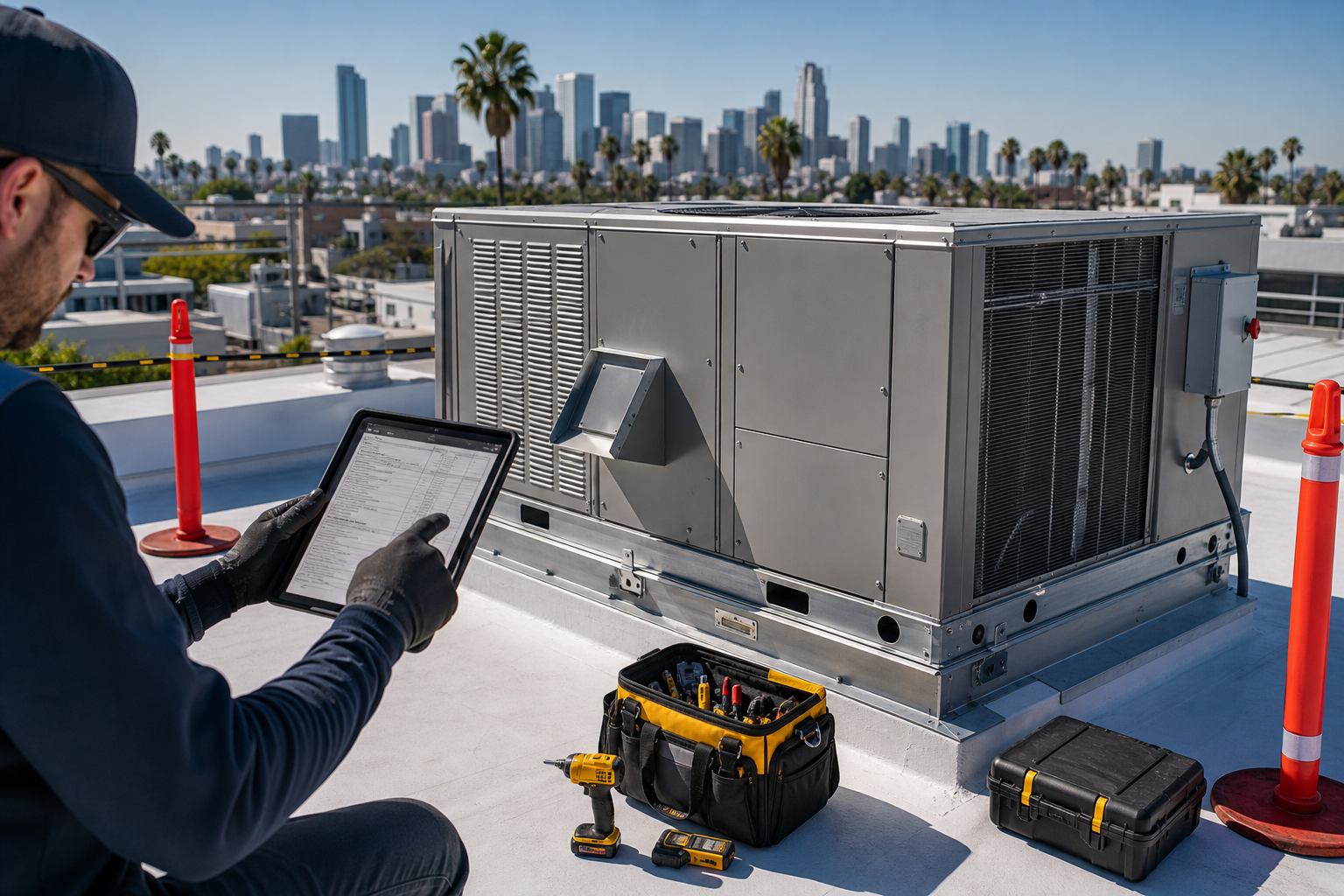
Before equipment is named, the Echo Park field walk records what the building is willing to give. roof hatch dimensions, crane or lift staging, curb condition, service clearance, electrical disconnect, condensate path, and building-manager coordination. We carry that into a written assumption set so the proposal can be defended later with photos and readings, not adjectives. Around Angelino Heights that often means rechecking roof access and economizer or vent settings after access is opened up.
Small-home installs still need readings because one wrong unit can be loud and ineffective. So the rooftop package unit bid we send for a Echo Park project is structured around proof, not promises: equipment match, route, drains, electrical, controls, and the file the homeowner keeps. A future technician should be able to read that file and understand the install without calling us.
A homeowner typing "Echo Park rooftop package unit" into a search bar is usually past the brochure stage and trying to figure out what could go sideways. The honest list for this scope here includes curb adapters missed and startup values skipped after crane day, plus whatever the building hides until access is opened. property owners and condo managers are comparing access, crane timing, curb adapters, tenant notices, noise, and whether package equipment can convert to heat pump operation. A bid that does not name those risks in writing is shifting them onto the homeowner without saying so.
Closeout documentation has one job: make the installed system legible without the installer in the room. For Echo Park we include access plan, model and serial photos, startup sheet, tenant or HOA closeout notes, plus model and serial photos, filter sizes, control settings, and a one-page operating note. If the system is a heat pump or inverter, the runtime profile is documented so the next technician knows whether the building is letting it cycle long and efficient or forcing it short.
Once the existing equipment is on the curb, the homeowner has crossed a one-way door. That is why this site is installation-first for Echo Park: a rooftop package unit done sloppily compounds for years through older envelopes, compact rooms, street dust, and rooms that trap heat and compact equipment, ductless placement, electrical readiness, and landlord coordination, and there is no quick fix once finishes are restored. The mitigation is field discipline before install day — measured, documented, and agreed in writing.
Even within Los Angeles, what works in a flat tract is wrong for Echo Park. The Eastside basin introduces older envelopes, compact rooms, street dust, and rooms that trap heat, and bungalows, duplexes, hillside rentals, and small additions introduces compact equipment, ductless placement, electrical readiness, and landlord coordination as a labor reality, not an inconvenience. A rooftop package unit bid that respects both will look different from the one written for a different ZIP, and that difference is the point.
If a Echo Park bid leans heavily on the manufacturer's name, the diagnostic question is what the contractor measures at startup. Mitsubishi, Daikin, Bosch, Trane, Carrier, Lennox, and Fujitsu equipment all need roof access and economizer or vent settings verified to reach rated performance. The brand can survive being installed quickly, but only if the commissioning step is non-negotiable; otherwise the homeowner is paying premium prices for average behavior.
What changes when the rooftop unit replacement happens in Echo Park
Local proof angle for Echo Park rooftop unit replacement.
A scope is only as good as the next service technician can read it. For Echo Park, the scope should explain how Elysian Heights, Angelino Heights, Historic Filipinotown edge building stock affects equipment placement, airflow, controls, drainage, finish protection, and the final owner record. A city-service page only earns its keep when it gives the homeowner a sharper checklist than a broad Los Angeles service page.
That is why the rooftop package unit conversation starts with the home: bungalows, duplexes, hillside rentals, and small additions. The same service can be easy in a flat postwar attic and difficult in a hillside remodel, ADU, condo stack, or coastal roof. The proposal should make those constraints visible before the old system is removed.
Startup measurements worth recording on a Echo Park rooftop unit replacement
Rooftop Unit Replacement commissioning focus in Echo Park.
The minimum written scope should describe curb fit, roof access, economizer or vent settings, startup amps, tenant notice timing, then connect each checkpoint to a finished deliverable. If the contractor says the system will be quiet, efficient, smoke-ready, rebate-ready, or better balanced, the closeout file should show which readings, photos, settings, or caveats support that claim.
For Echo Park searches, long-tail intent usually means the homeowner already knows the service category and wants a local risk answer. Common issues such as roof access promised too casually, curb adapters missed, startup values skipped after crane day should not be discovered after equipment is ordered. They belong in the pre-install notes, with the limits stated plainly when the building will not let the system perform like a brochure.
How a Echo Park homeowner separates a rooftop unit replacement bid from a brochure
Echo Park rooftop unit replacement planning range before access.
A premium label can raise the ceiling, but it cannot overcome poor installation discipline. The quote that looks expensive may be the better value if it includes model-match evidence, startup values, route photos, filter and control setup, warranty handoff, and clear exclusions. The quote that looks cheaper can become costly when it skips the proof points that decide comfort.
Cali HVAC treats the closeout as part of the product. For a Echo Park rooftop package unit, that means the homeowner should receive access plan, model and serial photos, startup sheet, tenant or HOA closeout notes in a format that can be used by a future technician, property manager, warranty desk, rebate reviewer, or owner representative.
Documents the Echo Park rooftop unit replacement should produce in writing
Echo Park rooftop unit replacement paperwork context.
LADWP territory makes rebate documentation a front-end question: active electric service, final approved permit, AHRI match, and application timing should be checked before the homeowner treats an incentive as certain. For rooftop package unit replacement, the research-backed document list is access plan, curb and adapter notes, serial photos, startup amps, economizer or ventilation settings, tenant notice timing, and permit closeout. LADWP currently publishes heat pump HVAC rebate tiers up to $2,500 per ton for qualifying systems, but it also ties eligibility to rules such as AHRI match, final approved Building and Safety permit, SEER2/HSPF2 rating, and available program funding. That is why the proposal should never treat a rebate as guaranteed money until the installed system and paperwork are confirmed.
Permitting deserves the same discipline. CSLB C-20 guidance and Los Angeles mechanical-permit references support a simple homeowner question: who is responsible for the permit record, final inspection, and closeout documents? In Echo Park, that question matters before equipment is ordered because compact equipment, ductless placement, electrical readiness, and landlord coordination. A clean rooftop package unit scope should state whether permit fees, HERS or field verification, electrical work, duct sealing, asbestos exclusions, HOA packets, or rebate filing support are included or excluded.
What Echo Park owners want clarified before signing a Rooftop Unit Replacement
Echo Park search intent for rooftop unit replacement.
The useful searcher is not asking "what is HVAC?" They are asking whether property owners and condo managers are comparing access, crane timing, curb adapters, tenant notices, noise, and whether package equipment can convert to heat pump operation. A page built for that intent should answer the decision instead of repeating broad comfort language. For this service, the field answer is roof hatch dimensions, crane or lift staging, curb condition, service clearance, electrical disconnect, condensate path, and building-manager coordination. That gives the homeowner a way to compare proposals using evidence instead of sales adjectives.
The hardest part is often not the new unit; it is access, fit, timing, and documenting what happened after the crane leaves. The best bid should make that tradeoff visible with photos, model numbers, installation constraints, startup readings, and plain-language exclusions. That keeps this page away from doorway behavior because the content is tied to a real Echo Park installation decision, a specific service, and documentation a homeowner can actually request.
Technical detail: how a Rooftop Unit Replacement actually gets commissioned
Commercial RTU swaps in the LA basin pull a different rulebook — NEC Article 440 disconnect, NEC 110.26 working clearance, structural sign-off on the curb adapter, and ASHRAE Standard 232-2024 commissioning if the building owner wants LEED or Title 24 nonresidential compliance. For a 7.5-ton replacement on 460V/3-phase serving a Glendale strip-mall tenant I default to the Carrier WeatherMaker 48TC because the curb dimensions on the existing 48HJ frame within 2 inches and a Carrier-to-Carrier adapter avoids fabricating sheet metal on the roof. When the building wants higher staging I quote the Trane Voyager Y or the Lennox Strategos with two-stage scroll, and on tight existing curbs I have used York Sunline because the footprint is shorter than the older Bryant equivalents. Crane day is the cost driver: I price a 30-ton boom truck for anything over 6 tons, and I confirm the roof live-load capacity with the building engineer before the lift because a 1980s Type V wood structure in Highland Park will not take 1,200 lbs of new equipment plus a full salt-corrosion-spec condenser fan motor without a beam reinforcement letter. AHRI 210/240 covers the matched performance certificate, refrigerant is now R-454B on most new platforms, and EPA Section 608 type II is the minimum cert for the recovery on the legacy R-410A. LADBS commercial mechanical permit, Glendale Water and Power or LADWP rebate paperwork, and SCAQMD Rule 1407 recovery documentation all go in the closeout package — I have watched a 6-month-old install fail audit because the recovery tank weight ticket was missing.
Proof checklist for a Rooftop Unit Replacement in Echo Park
- structural engineer letter for curb load and roof capacity
- AHRI 210/240 matched certificate for the new RTU model
- refrigerant recovery weight ticket per SCAQMD Rule 1407
- crane lift plan with rigging diagram and certified operator
- commissioning per ASHRAE 232-2024 with airflow and charge log
- LADBS or local AHJ commercial mechanical permit final card
- EPA 608 type II technician card for any 410A recovery
- NEC 110.26 working clearance photos and disconnect labeling
Long-tail questions homeowners ask about a Echo Park Rooftop Unit Replacement
- Carrier WeatherMaker 48TC 7.5 ton replacement cost Glendale
- rooftop package unit curb adapter Carrier 48HJ to 48TC
- Trane Voyager Y vs Lennox Strategos 10 ton commercial RTU
- York Sunline short curb footprint replacement LA
- crane cost RTU replacement 30 ton boom truck Los Angeles
- roof live load capacity 1980s Type V wood structure RTU
- Glendale Water and Power commercial HVAC rebate 2026
- ASHRAE Standard 232-2024 commissioning RTU LEED
- R-410A recovery weight ticket SCAQMD Rule 1407
- NEC Article 440 disconnect 460V 3 phase RTU clearance
What belongs in the Echo Park closeout file
- access plan
- model and serial photos
- startup sheet
- tenant or HOA closeout notes
- curb fit
- roof access
- economizer or vent settings
- startup amps
- tenant notice timing
Data points used across this site are anchored to LADBS mechanical permits, 2025 California Energy Code, LADWP heat pump rebates, TECH Clean California reservation status, CSLB C-20 permit enforcement, California HERS field verification, ACCA Manual J S and D design, AHRI matched system certificates, ENERGY STAR quality installation, EPA wildfire smoke filtration, ENERGY STAR duct losses. Program details can change, so rebate, permit, and code assumptions should be verified at the time of installation.