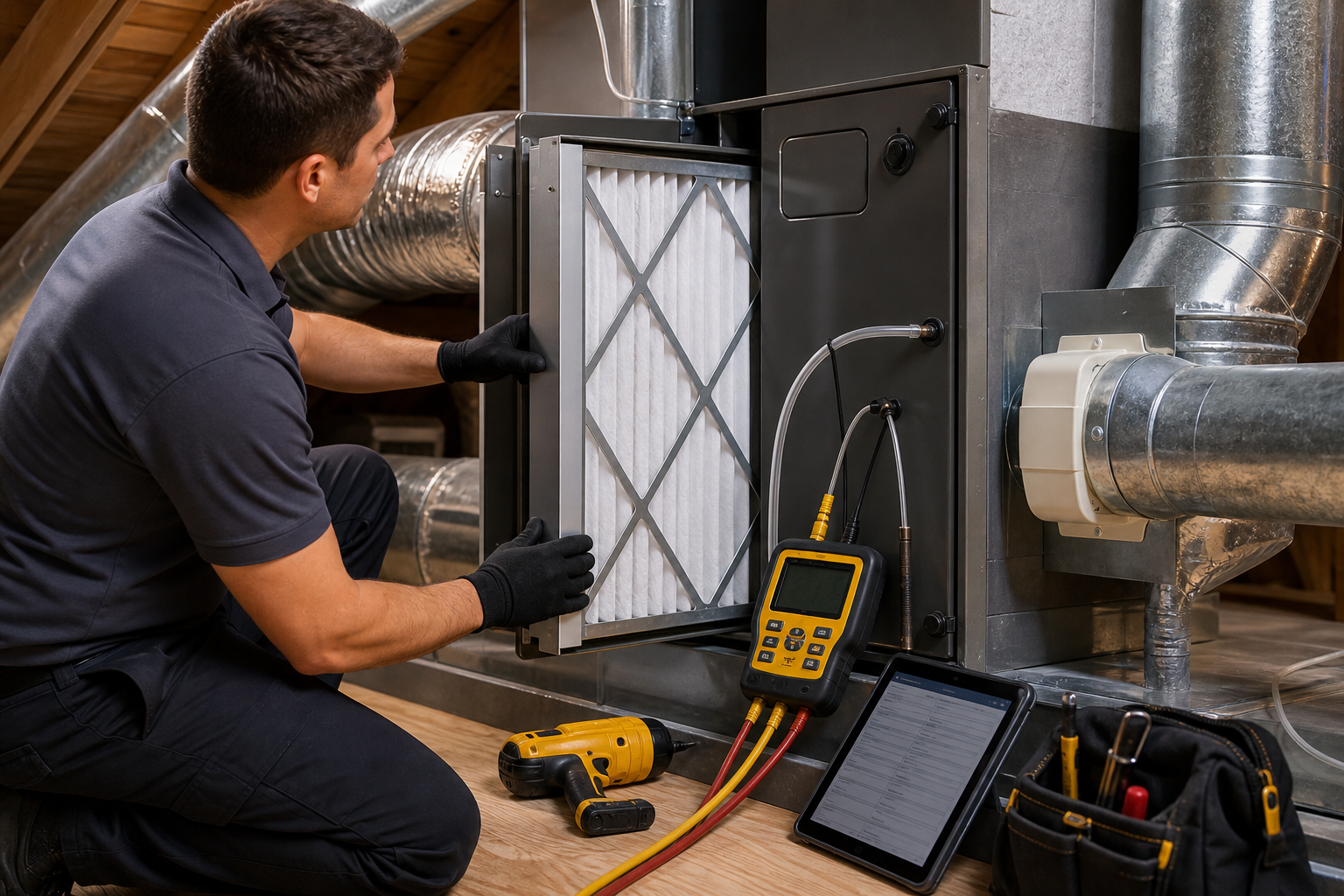
How a Filtration Upgrade actually gets installed in LA
Filtration upgrades in the LA airshed are not optional anymore — the EPA wildfire-smoke guidance and SCAQMD particulate alerts have pushed MERV 13 from a nice-to-have to a baseline, and ASHRAE 62.2-2022 sets the mechanical ventilation floor at roughly 7.5 CFM per person plus 3 CFM per 100 sqft. The trap is pressure drop: a 1-inch MERV 16 filter on a Bryant Preferred 226A or any 0.5 in.w.c. external static rated blower will pull static to 0.78 in.w.c. and starve the coil. The fix is a 4 to 5 inch deep media cabinet — Aprilaire 1620 for MERV 13 or Aprilaire 5000 with the polarized media for finer capture — sized to roughly 500 fpm face velocity so the cartridge lasts 9 to 12 months and the blower never sees more than 0.15 in.w.c. across the filter. Ventilation gets bolted on with a balanced ERV: RenewAire EV Premium 90H or the Broan AI Series ERV ducted into the return, with a fresh-air damper interlocked to a 24V signal so it does not pull smoke during a Red Flag event. Wildfire mode on the smart thermostat — ecobee Premium has it native — closes the OA damper and switches to recirculate. SCAQMD Rule 1407 covers the refrigerant side of any work and Title 24 §150.0(o) sets the IAQ ventilation requirement on new construction and major remodels. I commission every install with a TSI or Testo manometer reading filter pressure drop, ERV flow per port, and CO2 decay so the homeowner has a baseline to retest in five years.
Filtration and Ventilation Upgrade should be quoted, scoped, and closed out as a system. The components that decide whether it works are filter cabinet fit, pressure drop, fan capability, smoke mode, maintenance access, and Cali HVAC commits each of them to a written record. The homeowner ends the project with a file rather than a feeling — which matters specifically because feelings about HVAC tend to shift after the first heat wave or cold snap, and the file does not.
This service is built for homeowners who do not want a box swap. Common failure points include high-MERV filter sold without airflow check, sealed homes without ventilation plan, filter slots that bypass dust. Those risks are not edge cases in Los Angeles; they are normal field conditions across older ducts, compact lots, rooftop equipment, hillside routes, ADUs, condos, and premium remodels.
What the homeowner walks away with: filter size and MERV notes, static pressure impact, smoke mode instructions, replacement calendar, plus photos, model numbers, startup readings, owner training, and the permit/rebate/warranty/building caveats spelled out. The record is structured so the next technician — yours, ours, or someone else's — can pick up the system without back-channeling.
Budget context lands around $650 to $12 500, depending on access, equipment tier, electrical scope, duct or line work, controls, and finish protection. The number tightens after the field walk. A bid that comes in well below the range and skips commissioning proof leaves the homeowner with no leverage if comfort issues surface later.
The valuable search behavior around filtration and ventilation upgrade clusters at wildfire smoke HVAC filter Los Angeles, MERV 13 HVAC upgrade, smoke mode thermostat, and ventilation upgrade LA. Those queries come from a homeowner who is no longer browsing brands and is instead asking whether homeowners are asking about wildfire smoke, MERV 13, air purifiers, fresh air, filter cabinets, and whether a dense filter will damage comfort. A page that earns those clicks has to answer that question in measurement-and-documentation terms, because the homeowner running those searches is already past the point where slogans are persuasive.
Documentation expected from this scope is filter size, MERV note, pressure-drop impact, smoke-mode instructions, maintenance interval, and any ventilation or fan-speed caveat. Field verification expected on this scope is blower capability, return leakage, filter bypass, cabinet depth, fan runtime, makeup air, and whether the home is tight enough to need ventilation planning. Higher-MERV filtration helps only when the blower and cabinet can handle it; otherwise the upgrade can reduce airflow and comfort. The reason both stacks are spelled out is that they are how the page distinguishes itself from category-level content — connecting the service to a real homeowner decision rather than to a list of features.
How this service gets documented
Los Angeles proof points for Filtration and Ventilation Upgrade
Ask any Los Angeles filtration upgrade bid one question — what about this house changed your scope — and the answer separates a written proposal from a quote-by-template. Spanish homes, apartments, ADUs, hillside additions, flat roofs, and mixed-age duct systems and marine layer mornings, valley spillover heat, smoke days, and room-by-room load swings should be in the answer, and so should old ducts, tight side yards, return-air limits, panel surprises, and LADBS permit sequencing. Cali HVAC starts there because the building gives the contractor a finite set of moves, and the proposal that respects that set is the one that performs.
Field discipline matters more than field charm. Our Los Angeles site visit logs pressure drop, fan capability, and smoke mode, captures the existing nameplate, photographs the planned equipment location, and writes down which Central LA basin conditions the new filtration upgrade will be expected to absorb. homeowners are asking about wildfire smoke, MERV 13, air purifiers, fresh air, filter cabinets, and whether a dense filter will damage comfort, so the visit also records what the homeowner is actually trying to fix, in their words, before any product family is suggested.
Tonnage is a starting point, not a scope. Our Los Angeles filtration upgrade bid expands from there into the indoor and outdoor match, the route through old ducts, tight side yards, return-air limits, panel surprises, and LADBS permit sequencing, drainage and electrical assumptions, controls, the photo plan, and the deliverable list. citywide installs need a record that separates equipment performance from building constraints, which means the bid has to do the work of the closeout file in advance — anything left implicit becomes a dispute later.
When the search query gets specific — "Los Angeles filtration upgrade" plus a symptom or a constraint — the homeowner is doing the contractor's diligence for them. The local risks that should already be in any serious bid are high-MERV filter sold without airflow check and sealed homes without ventilation plan, with old ducts, tight side yards, return-air limits, panel surprises, and LADBS permit sequencing as the labor wildcard. homeowners are asking about wildfire smoke, MERV 13, air purifiers, fresh air, filter cabinets, and whether a dense filter will damage comfort, and a written acknowledgment of those risks is what separates a real scope from a templated city landing page.
The commissioning proof pack is the practical difference. It can include filter size and MERV notes, static pressure impact, smoke mode instructions, replacement calendar, model and serial photos, filter sizes, thermostat or control settings, and owner maintenance notes. For heat pump and inverter systems, the file should also make clear whether the system is configured for long efficient cycles or whether the building is forcing short runtime.
Replacement is the moment the homeowner cannot easily walk back. A bad filtration upgrade ages with the home for a decade: noise, dust, uneven rooms, ugly bills, warranty disputes. In Los Angeles the cure is field discipline before install day, so the crew already knows about return-air constraints, attic clearances, or equipment placement conflicts before the old unit is on the curb.