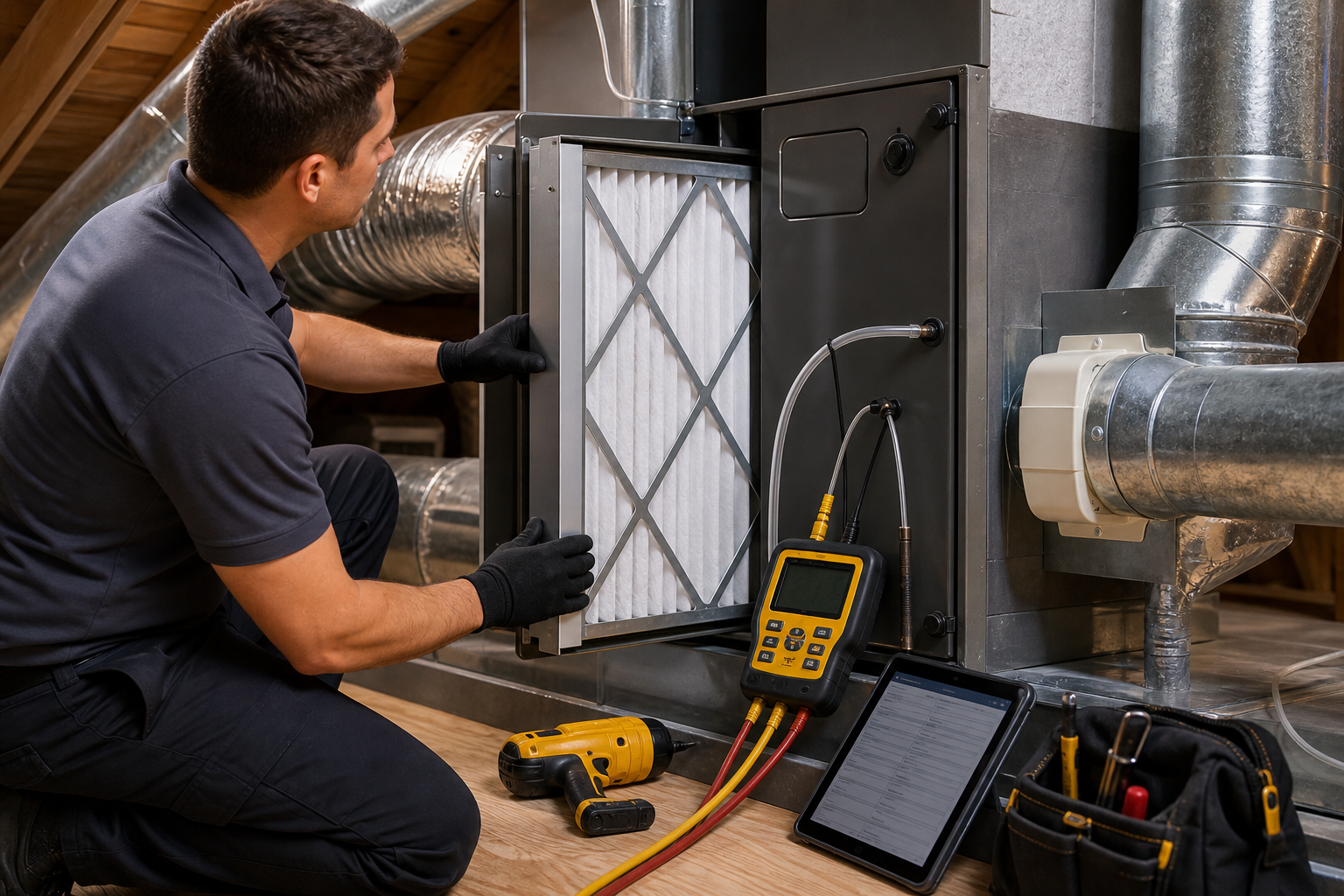
What changes about a filtration upgrade once you cross into Woodland Hills
Walnut Acres mid-century ranches along Vanalden and Quedo were built with low-slope roofs and shallow attics, which forces hard decisions about whether the air handler belongs in a closet, a garage, or stays where the original gas furnace lived. Warner Center high-rise condos along Topanga Canyon Boulevard and Owensmouth carry their own constraints — through-wall PTAC replacements, refrigerant line riser limits, and HOA approval cycles that can stretch six weeks. Vista de Oro hillside homes off Mulholland Drive sit in one of the hottest pockets in the entire LA basin; National Weather Service readings at Pierce College have hit 117. Any system sized to a generic CFM-per-ton rule will short cycle and never dehumidify properly during a humid monsoon push. We default to two-stage or fully modulating equipment — Trane XV20i, Lennox SL25XPV, or the Carrier Infinity 26 variable-speed — and confirm AHRI matched coil and condenser pairing on the certificate before pulling the LADWP permit. Refrigerant lockout, line-set evacuation to 500 microns, and a documented startup with subcooling and superheat at design conditions are non-negotiable, and the homeowner gets a copy of the printout.
Equipment quotes are easy. A defensible filtration upgrade scope for Woodland Hills is harder, because it has to reconcile large attic systems, ranch homes, hillside remodels, and older insulation with extreme summer heat, attic temperatures, long compressor runtime, and smoke events and still fit through load calculations, duct redesign, heat pump sizing, panel readiness, and high-heat startup. Cali HVAC writes proposals that put those reconciliations on the page in plain words, so the homeowner sees the trade-offs the crew will face and can compare bids against the same field reality instead of against marketing.
The opening visit in Woodland Hills reads more like a building inspection than a sales call. We record fan capability and smoke mode, photograph the equipment locations, and note where load calculations, duct redesign, heat pump sizing, panel readiness, and high-heat startup will affect labor sequence. blower capability, return leakage, filter bypass, cabinet depth, fan runtime, makeup air, and whether the home is tight enough to need ventilation planning. Around Walnut Acres the same patterns repeat enough that the file also flags what we cannot know until access is opened, so the proposal lists assumptions instead of pretending they are facts.
A defensible bid for a Woodland Hills filtration upgrade answers four questions in writing: what is being installed, how it routes through the building, what assumptions could change the price, and what the homeowner receives at closeout. replacement calendar and filter size and MERV notes are explicit, not implied. commissioning should prove performance under a realistic valley load, not mild weather only, so the proposal carries that proof structure from day one rather than waiting until the post-install conversation.
For long-tail searches like Woodland Hills filtration upgrade, the useful answer is not a generic paragraph about comfort. The useful answer is what changes the installation. We flag risks such as high-MERV filter sold without airflow check, sealed homes without ventilation plan, filter slots that bypass dust. We also state what we are not promising. If ducts, filters, panel capacity, HOA rules, roof access, or load conditions limit the outcome, those limitations belong in the proposal before anyone signs.
What the proof pack actually contains for a Woodland Hills filtration upgrade: replacement calendar, filter size and MERV notes, model and serial photos, filter sizes, thermostat or control settings, and owner maintenance notes. The package should answer "what was done and how do I prove it" six months later, when the original sales contact is unreachable.
Why this site is installation-first: a $200 repair mistake gets fixed next week, but a wrong filtration upgrade keeps charging the homeowner for a decade in noise, comfort gaps, runtime, and warranty friction. Around Woodland Hills the savings come from the slow work before install day — verifying ducts, access, electrical, and equipment fit before anything is removed.
Even within Los Angeles, Woodland Hills reads differently from a flat valley tract. The West Valley heat belt brings extreme summer heat, attic temperatures, long compressor runtime, and smoke events; large attic systems, ranch homes, hillside remodels, and older insulation adds its own constraints. A filtration upgrade bid that does not acknowledge those is borrowing trouble.
The brand sticker is the smallest variable in whether a filtration upgrade performs. Mitsubishi, Daikin, Bosch, Trane, Carrier, Lennox, and Fujitsu all engineer past the average install — but they assume the contractor will respect airflow, charge, line set, controls, and filter pressure drop. In Woodland Hills, where load calculations, duct redesign, heat pump sizing, panel readiness, and high-heat startup can quietly compromise any of those, the commissioning record is what makes the brand promise survive contact with the building.
Why a Woodland Hills Filtration Upgrade reads differently on site
Local proof angle for Woodland Hills filtration upgrade.
The point of a closeout is to make the install legible without reopening anything. For Woodland Hills, the scope should explain how how LADWP and SoCalGas shapes a Woodland Hills install affects equipment placement, airflow, controls, drainage, finish protection, and the final owner record. A city-service page only earns its keep when it gives the homeowner a sharper checklist than a broad Los Angeles service page.
That is why the filtration upgrade conversation starts with the home: large attic systems, ranch homes, hillside remodels, and older insulation. The same service can be easy in a flat postwar attic and difficult in a hillside remodel, ADU, condo stack, or coastal roof. The proposal should make those constraints visible before the old system is removed.
Woodland Hills Filtration Upgrade proof checkpoints
Filtration Upgrade commissioning focus in Woodland Hills.
The minimum written scope should describe filter cabinet fit, pressure drop, fan capability, smoke mode, maintenance access, then connect each checkpoint to a finished deliverable. If the contractor says the system will be quiet, efficient, smoke-ready, rebate-ready, or better balanced, the closeout file should show which readings, photos, settings, or caveats support that claim.
For Woodland Hills searches, long-tail intent usually means the homeowner already knows the service category and wants a local risk answer. Common issues such as high-MERV filter sold without airflow check, sealed homes without ventilation plan, filter slots that bypass dust should not be discovered after equipment is ordered. They belong in the pre-install notes, with the limits stated plainly when the building will not let the system perform like a brochure.
Side-by-side bid comparison for a Woodland Hills filtration upgrade
Woodland Hills filtration upgrade planning range before access.
A premium label can raise the ceiling, but it cannot overcome poor installation discipline. The quote that looks expensive may be the better value if it includes model-match evidence, startup values, route photos, filter and control setup, warranty handoff, and clear exclusions. The quote that looks cheaper can become costly when it skips the proof points that decide comfort.
Cali HVAC treats the closeout as part of the product. For a Woodland Hills filtration upgrade, that means the homeowner should receive filter size and MERV notes, static pressure impact, smoke mode instructions, replacement calendar in a format that can be used by a future technician, property manager, warranty desk, rebate reviewer, or owner representative.
Permit, rebate, and AHRI context for a Woodland Hills filtration upgrade
Woodland Hills filtration upgrade paperwork context.
LADWP territory makes rebate documentation a front-end question: active electric service, final approved permit, AHRI match, and application timing should be checked before the homeowner treats an incentive as certain. For filtration and ventilation upgrade, the research-backed document list is filter size, MERV note, pressure-drop impact, smoke-mode instructions, maintenance interval, and any ventilation or fan-speed caveat. LADWP currently publishes heat pump HVAC rebate tiers up to $2,500 per ton for qualifying systems, but it also ties eligibility to rules such as AHRI match, final approved Building and Safety permit, SEER2/HSPF2 rating, and available program funding. That is why the proposal should never treat a rebate as guaranteed money until the installed system and paperwork are confirmed.
Permitting deserves the same discipline. CSLB C-20 guidance and Los Angeles mechanical-permit references support a simple homeowner question: who is responsible for the permit record, final inspection, and closeout documents? In Woodland Hills, that question matters before equipment is ordered because load calculations, duct redesign, heat pump sizing, panel readiness, and high-heat startup. A clean filtration upgrade scope should state whether permit fees, HERS or field verification, electrical work, duct sealing, asbestos exclusions, HOA packets, or rebate filing support are included or excluded.
The buyer questions a Woodland Hills filtration upgrade bid should answer in writing
Woodland Hills search intent for filtration upgrade.
The useful searcher is not asking "what is HVAC?" They are asking whether homeowners are asking about wildfire smoke, MERV 13, air purifiers, fresh air, filter cabinets, and whether a dense filter will damage comfort. A page built for that intent should answer the decision instead of repeating broad comfort language. For this service, the field answer is blower capability, return leakage, filter bypass, cabinet depth, fan runtime, makeup air, and whether the home is tight enough to need ventilation planning. That gives the homeowner a way to compare proposals using evidence instead of sales adjectives.
Higher-MERV filtration helps only when the blower and cabinet can handle it; otherwise the upgrade can reduce airflow and comfort. The best bid should make that tradeoff visible with photos, model numbers, installation constraints, startup readings, and plain-language exclusions. That keeps this page away from doorway behavior because the content is tied to a real Woodland Hills installation decision, a specific service, and documentation a homeowner can actually request.
Technical detail: how a Filtration Upgrade actually gets commissioned
Filtration upgrades in the LA airshed are not optional anymore — the EPA wildfire-smoke guidance and SCAQMD particulate alerts have pushed MERV 13 from a nice-to-have to a baseline, and ASHRAE 62.2-2022 sets the mechanical ventilation floor at roughly 7.5 CFM per person plus 3 CFM per 100 sqft. The trap is pressure drop: a 1-inch MERV 16 filter on a Bryant Preferred 226A or any 0.5 in.w.c. external static rated blower will pull static to 0.78 in.w.c. and starve the coil. The fix is a 4 to 5 inch deep media cabinet — Aprilaire 1620 for MERV 13 or Aprilaire 5000 with the polarized media for finer capture — sized to roughly 500 fpm face velocity so the cartridge lasts 9 to 12 months and the blower never sees more than 0.15 in.w.c. across the filter. Ventilation gets bolted on with a balanced ERV: RenewAire EV Premium 90H or the Broan AI Series ERV ducted into the return, with a fresh-air damper interlocked to a 24V signal so it does not pull smoke during a Red Flag event. Wildfire mode on the smart thermostat — ecobee Premium has it native — closes the OA damper and switches to recirculate. SCAQMD Rule 1407 covers the refrigerant side of any work and Title 24 §150.0(o) sets the IAQ ventilation requirement on new construction and major remodels. I commission every install with a TSI or Testo manometer reading filter pressure drop, ERV flow per port, and CO2 decay so the homeowner has a baseline to retest in five years.
Proof checklist for a Filtration Upgrade in Woodland Hills
- pre-install and post-install static pressure across the filter
- ASHRAE 62.2-2022 ventilation calc showing CFM target met
- ERV port flow measurements (supply and exhaust) in CFM
- wildfire mode wiring confirmation on smart thermostat
- media cabinet face velocity calculation ≤ 500 fpm
- CF2R-MCH form for mechanical ventilation if Title 24 applies
- CO2 decay or PM2.5 baseline reading at commissioning
- manufacturer warranty registration for ERV and filter cabinet
Long-tail questions homeowners ask about a Woodland Hills Filtration Upgrade
- Aprilaire 1620 MERV 13 media filter cabinet install Los Angeles
- Aprilaire 5000 polarized media filter pressure drop
- RenewAire EV Premium 90H install retrofit return duct
- Broan AI Series ERV ducted to return wildfire mode
- wildfire smoke MERV 13 EPA recommendation HVAC LA
- ecobee Premium wildfire mode close fresh air damper
- ASHRAE 62.2-2022 ventilation rate calculator Los Angeles
- 1 inch MERV 16 filter static pressure 0.78 fix media cabinet
- Title 24 150.0(o) IAQ ventilation requirement remodel
- ERV commissioning CFM port balance test residential
What belongs in the Woodland Hills closeout file
- filter size and MERV notes
- static pressure impact
- smoke mode instructions
- replacement calendar
- filter cabinet fit
- pressure drop
- fan capability
- smoke mode
- maintenance access
Data points used across this site are anchored to LADBS mechanical permits, 2025 California Energy Code, LADWP heat pump rebates, TECH Clean California reservation status, CSLB C-20 permit enforcement, California HERS field verification, ACCA Manual J S and D design, AHRI matched system certificates, ENERGY STAR quality installation, EPA wildfire smoke filtration, ENERGY STAR duct losses. Program details can change, so rebate, permit, and code assumptions should be verified at the time of installation.