What changes about a air handler and coil once you cross into Encino
Encino Hills properties off Mulholland and Hayvenhurst tend to be 4,000 to 8,000 square foot two-stories with vaulted entries that load up west sun starting at 2 PM, and the typical builder-grade single-stage 5-ton in the attic was never going to keep the master bedroom under 78 in August. Amestoy Estates ranches on flag lots have detached pool houses and ADUs that owners want on independent zones, which usually steers us toward Daikin VRV LIFE or a multi-position air handler with a separate small condenser rather than overloading the main system. Lake Encino's gated stock has CC&Rs restrictions on visible equipment that drive condenser placement decisions before any thermodynamic ones. The Sepulveda Pass funnels hot afternoon air directly over Encino, and Skirball-area readings of 112 are not unusual. We design to Manual J ACCA, not rule of thumb, calculate static pressure for the actual installed duct geometry, and confirm refrigerant subcooling within 1 degree of manufacturer target before the inverter compressor sees its first long-cycle call. Owners here want the documentation, and we provide it on every project without being asked.
Most Encino homeowners do not need another sales page about comfort. They need a air handler and coil scope that names what the building gives the contractor to work with: large homes, older ducts, pool-adjacent condensers, additions, and multi-system layouts, west valley heat, event occupancy, glass loads, and bedroom wings with different loads, and multi-system sequencing, duct corrections, quiet outdoor placement, and service access. Cali HVAC starts every proposal with those constraints visible, then moves on to equipment.
The opening visit for a Encino air handler and coil is short on opinion and long on observation. We measure or photograph filter cabinet, blower setup, and service clearance, log the LADWP and SoCalGas service context, and write down what the South Valley west climate is asking the system to handle. Equipment selection comes after, not before.
A air handler and coil bid earns its keep by being legible six months later. For Encino, ours names the equipment family and indoor-outdoor match, the line or duct route through multi-system sequencing, duct corrections, quiet outdoor placement, and service access, drainage and electrical assumptions, the photo and reading plan, and the closeout file the homeowner keeps. system labels and readings prevent one blended quote from hiding which zone failed, so the bid is structured as evidence-in-advance — every claim has a corresponding line item that can be checked on install day or six months out.
The long-tail query exists because the short-tail answer was not specific enough. For a air handler and coil in Encino, the specifics that change the install are coil mismatch, filter access made worse, drains rebuilt without overflow protection. Those belong in the proposal — with the limit the contractor will and will not own — not in the post-install phone call. homeowners are usually trying to preserve a working outdoor unit, replace the indoor side, or convert a furnace/coil stack to heat pump-ready components, which means the page that helps is the one willing to talk about failure modes.
A real proof pack reads like a building file, not a marketing leave-behind. For Encino air handler and coil closeout, expect coil and furnace matchup and drain photos alongside model photos, filter spec, electrical readings, control settings, and operating notes. coil match, blower setup, drain photos, filter size, service clearance, warranty status, and AHRI reference where the match matters is filed in the same package so a future appraiser, owner-rep, or service technician can verify the system without reconstructing history from invoices.
Replacement projects punish optimism. A air handler and coil that ignored coil mismatch or filter access made worse during planning becomes a series of compromises baked into the building: longer runtimes, dirtier filters, hotter rooms, louder cabinets. In Encino the safeguard is the slow front end — load assumptions checked, return-air verified, attic or roof access measured, line or duct route confirmed — all before the existing equipment is touched.
Encino earns its own page because the South Valley west produces a load profile a generic template cannot describe. west valley heat, event occupancy, glass loads, and bedroom wings with different loads and large homes, older ducts, pool-adjacent condensers, additions, and multi-system layouts together push the air handler and coil scope toward decisions a citywide page would smooth over: filtration tier, outdoor placement, control logic, runtime expectations. Putting those decisions on a city-specific page is how the bid stays honest.
Brand quality and install quality are independent variables. Mitsubishi, Daikin, Bosch, Trane, Carrier, and Lennox can each be installed well or installed poorly, and the home will tell the truth either way within a season. The reason this site keeps tying the brand pages back to the commissioning file is that, in Encino, system labels and readings prevent one blended quote from hiding which zone failed — and proof lives in readings, not in marketing.
Field realities behind a Encino air handler and coil
Local proof angle for Encino air handler and coil.
Documentation is the part of the install that keeps working after the truck leaves. For Encino, the scope should explain how LADWP and SoCalGas documentation and utility context affects equipment placement, airflow, controls, drainage, finish protection, and the final owner record. A city-service page only earns its keep when it gives the homeowner a sharper checklist than a broad Los Angeles service page.
That is why the air handler and coil conversation starts with the home: large homes, older ducts, pool-adjacent condensers, additions, and multi-system layouts. The same service can be easy in a flat postwar attic and difficult in a hillside remodel, ADU, condo stack, or coastal roof. The proposal should make those constraints visible before the old system is removed.
The Encino air handler and coil numbers a closeout has to capture
Air Handler and Coil commissioning focus in Encino.
The minimum written scope should describe coil match, drain safety, filter cabinet, blower setup, service clearance, then connect each checkpoint to a finished deliverable. If the contractor says the system will be quiet, efficient, smoke-ready, rebate-ready, or better balanced, the closeout file should show which readings, photos, settings, or caveats support that claim.
For Encino searches, long-tail intent usually means the homeowner already knows the service category and wants a local risk answer. Common issues such as coil mismatch, filter access made worse, drains rebuilt without overflow protection should not be discovered after equipment is ordered. They belong in the pre-install notes, with the limits stated plainly when the building will not let the system perform like a brochure.
Reading two Encino Air Handler and Coil proposals on the same evidence
Encino air handler and coil planning range before access.
A premium label can raise the ceiling, but it cannot overcome poor installation discipline. The quote that looks expensive may be the better value if it includes model-match evidence, startup values, route photos, filter and control setup, warranty handoff, and clear exclusions. The quote that looks cheaper can become costly when it skips the proof points that decide comfort.
Cali HVAC treats the closeout as part of the product. For a Encino air handler and coil, that means the homeowner should receive coil and furnace matchup, drain photos, blower setup notes, filter size handoff in a format that can be used by a future technician, property manager, warranty desk, rebate reviewer, or owner representative.
Filing requirements around a Encino Air Handler and Coil
Encino air handler and coil paperwork context.
LADWP territory makes rebate documentation a front-end question: active electric service, final approved permit, AHRI match, and application timing should be checked before the homeowner treats an incentive as certain. For air handler, furnace, and coil installation, the research-backed document list is coil match, blower setup, drain photos, filter size, service clearance, warranty status, and AHRI reference where the match matters. LADWP currently publishes heat pump HVAC rebate tiers up to $2,500 per ton for qualifying systems, but it also ties eligibility to rules such as AHRI match, final approved Building and Safety permit, SEER2/HSPF2 rating, and available program funding. That is why the proposal should never treat a rebate as guaranteed money until the installed system and paperwork are confirmed.
Permitting deserves the same discipline. CSLB C-20 guidance and Los Angeles mechanical-permit references support a simple homeowner question: who is responsible for the permit record, final inspection, and closeout documents? In Encino, that question matters before equipment is ordered because multi-system sequencing, duct corrections, quiet outdoor placement, and service access. A clean air handler and coil scope should state whether permit fees, HERS or field verification, electrical work, duct sealing, asbestos exclusions, HOA packets, or rebate filing support are included or excluded.
Specific issues a Encino air handler and coil proposal should resolve up front
Encino search intent for air handler and coil.
The useful searcher is not asking "what is HVAC?" They are asking whether homeowners are usually trying to preserve a working outdoor unit, replace the indoor side, or convert a furnace/coil stack to heat pump-ready components. A page built for that intent should answer the decision instead of repeating broad comfort language. For this service, the field answer is cabinet dimensions, drain safety, coil orientation, blower profile, filter access, return leakage, and service clearance. That gives the homeowner a way to compare proposals using evidence instead of sales adjectives.
Indoor components decide airflow, filtration, drainage, and serviceability; replacing only the outdoor equipment can leave the real bottleneck untouched. The best bid should make that tradeoff visible with photos, model numbers, installation constraints, startup readings, and plain-language exclusions. That keeps this page away from doorway behavior because the content is tied to a real Encino installation decision, a specific service, and documentation a homeowner can actually request.
Technical detail: how a Air Handler and Coil actually gets commissioned
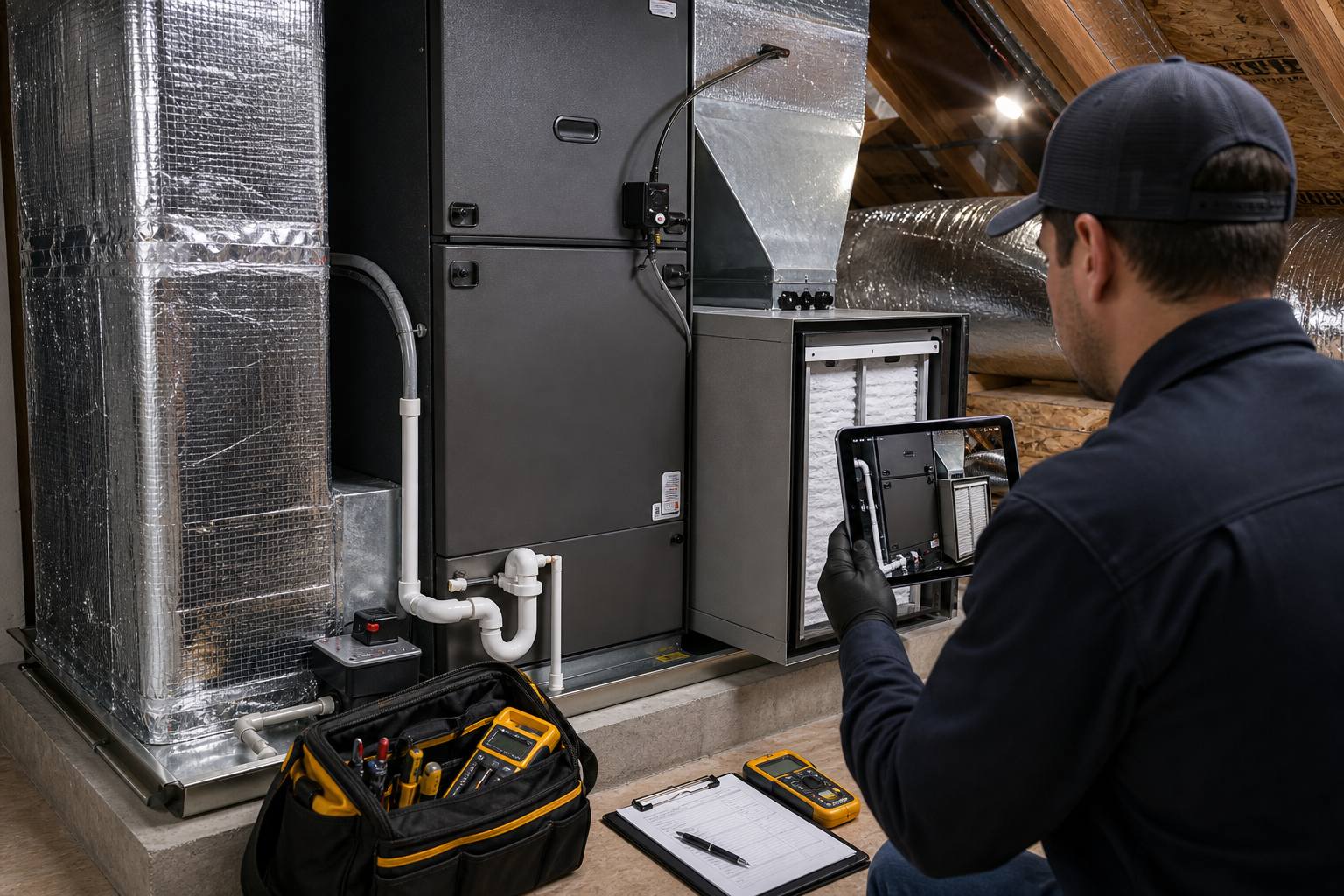
Air handler and coil swaps look simple on paper and almost always uncover a downstream problem — the supply plenum is undersized, the secondary drain pan is rusted out, or the existing 80% gas furnace is venting into a B-vent that no longer meets the rise-and-clearance table. On a Carrier replacement the FV4CNF005 fan coil mates cleanly to the 24VNA6 condenser at 1,600 CFM nominal, but I always re-pitch the condensate trap to 1/4 inch per foot and replace the float switch on the secondary pan because a clogged primary on a horizontal install in a Tarzana attic will dump 3 gallons through the drywall in under an hour. For Trane retrofits I match the TAM7B0C42 to the 4TWV0048A1000B and run a fresh 3/4 PVC primary to a visible termination per code. Coil-only changeouts during an R-410A to R-454B transition need a fresh filter-drier sized to the metering device, a triple flush of the line-set if it is staying, and a vacuum to 500 microns held 30 minutes. I had a Lennox CBA38MV-024 short-cycle on humidity within two months because the prior tech reused a TXV from the legacy R-22 coil — the bulb response curve is different and the superheat hunted constantly. NEC 110.26 working clearance applies to the air handler service panel, and Title 24 §150.0(m) duct sealing applies to any plenum modification over 6 ft of new sheet metal. LADBS will pull the permit if the gas line is touched on a furnace-to-coil conversion.
Proof checklist for a Air Handler and Coil in Encino
- photo of new TXV or piston metering device matched to R-454B coil
- condensate primary pitch and secondary float switch verification
- vacuum log to 500 microns held 30 minutes with isolation
- AHRI matched certificate for coil and condenser combination
- plenum transition photos showing sealed sheet metal joints
- gas line pressure test result if furnace was touched
- LADBS mechanical permit number and final inspection card
- commissioning supply temperature split and blower CFM at nameplate
Long-tail questions homeowners ask about a Encino Air Handler and Coil
- Carrier FV4CNF005 fan coil install attic horizontal Tarzana
- Trane TAM7B0C42 air handler match 4TWV0048A1000B
- Lennox CBA38MV-024 TXV replacement R-454B retrofit
- coil only replacement filter drier sizing R-454B
- condensate float switch secondary pan attic install code LA
- gas furnace to electric coil conversion permit LADBS
- air handler horizontal vs upflow plenum sizing 1600 CFM
- R-410A to R-454B coil swap line set triple flush procedure
- B-vent rise clearance table furnace replacement Los Angeles
- air handler NEC 110.26 service clearance attic install
What belongs in the Encino closeout file
- coil and furnace matchup
- drain photos
- blower setup notes
- filter size handoff
- coil match
- drain safety
- filter cabinet
- blower setup
- service clearance
Data points used across this site are anchored to LADBS mechanical permits, 2025 California Energy Code, LADWP heat pump rebates, TECH Clean California reservation status, CSLB C-20 permit enforcement, California HERS field verification, ACCA Manual J S and D design, AHRI matched system certificates, ENERGY STAR quality installation, EPA wildfire smoke filtration, ENERGY STAR duct losses. Program details can change, so rebate, permit, and code assumptions should be verified at the time of installation.