What changes about a zoning and controls once you cross into Koreatown
Koreatown's density and its mid-century building stock collide in ways that make every job a negotiation with the existing structure. The 1960s and 1970s dingbat apartments along Kenmore, Ardmore, and 8th Street were built before any meaningful energy code and rarely have central HVAC; retrofits frequently involve a Mitsubishi MXZ multi-zone outdoor unit on the roof feeding wall cassettes through carefully routed line covers down a stucco facade. The Wilshire Center high-rises are central-plant buildings where in-unit work is fan-coil replacement, not refrigerant work. Oxford Square's edge of historic single-family — Spanish, Tudor, and Craftsman from the 1910s and 1920s — sits inside an HPOZ where exterior equipment placement has to clear the Cultural Heritage Commission, not just LADBS. The 6th Street corridor's newer mid-rise residential is mostly heat-pump VRF already and the work is commissioning and controls integration rather than swap-out. Outside-air ventilation under ASHRAE 62.2-2022 is the underappreciated constraint in tight stucco apartments where smoking and cooking odors travel. We commission every multi-zone with manufacturer-specified line-set lengths, a measured refrigerant charge, and a written supply-temperature split per indoor unit handed to the owner.
The zoning and controls conversation in Koreatown works better when it begins with what the building is, not what the catalog offers. apartments, condos, courtyard buildings, and compact homes and dense traffic, shared walls, limited mechanical space, and roof heat are not abstractions on this side of the foothills; they decide whether a system runs long efficient cycles or fights the house. Cali HVAC reads those conditions first, then writes a scope that respects condensate pumps, ductless placement, compact filtration, and building access rules before any equipment family is named.
Site visits exist to remove guesses, not to create momentum. For a Koreatown zoning and controls we measure owner training, photograph short-cycle prevention, check the LADWP and SoCalGas service entry, and write down which Central density zone climate behaviors the new system will be answering. The file produced on that visit is the document the bid is built on; if a contractor cannot produce one, the bid is a guess wearing a price tag.
A conventional bid can hide too much behind a tonnage number. Our zoning and controls recommendation names the equipment family, the indoor and outdoor match, the route, the drainage or electrical assumptions, and the owner handoff. The closeout file is designed to make a future service technician, property manager, or homeowner understand why the system was installed the way it was. That matters in Koreatown because a compact install needs honest documentation of approvals, drains, sound, and service access.
Searches like "Koreatown zoning and controls" deserve a real answer, not a coupon. The honest answer in Koreatown usually involves at least one of these risks: sensors placed where they lie, or zoning added to ducts that cannot handle it. The proposal should call those out instead of pretending the install is identical to a flat-lot suburban tract.
Closeout is where the zoning and controls stops being a sales conversation and becomes a documented installed system. Expect control map, sensor placement notes, staging setup, owner training summary in the file, plus photos, filter dimensions, control settings, and operating notes. If the closeout for an inverter or heat pump system does not address runtime profile, the file is incomplete.
Replacement work is uniquely unforgiving. Once the old zoning and controls target is removed and the wall is closed, fixing a sizing or airflow mistake is expensive. So in Koreatown we move slowly on the front end: load assumptions, return-air check, attic or roof access, line or duct route — all settled before the crew shows up. The reward is an install day with no surprises.
Geography is not decorative on these pages. Koreatown sits inside the Central density zone, where dense traffic, shared walls, limited mechanical space, and roof heat change what the system has to do hour by hour. apartments, condos, courtyard buildings, and compact homes adds its own constraints on labor and routing. A zoning and controls bid that does not adjust for those inputs is borrowing assumptions from a different city, and the homeowner pays for that borrowing in the first season.
Premium equipment can outperform a budget unit, but only when the install does not drag it back to average. Mitsubishi, Daikin, Bosch, Trane, Carrier, and Lennox systems all have well-documented failure modes that originate in installation, not engineering. For a Koreatown zoning and controls, owner training and short-cycle prevention are how those failure modes get caught and prevented before the homeowner is the one finding them.
Koreatown field conditions that change a hvac zoning controls
Local proof angle for Koreatown hvac zoning controls.
A useful proposal names the condition, the decision, and the verification method. For Koreatown, the scope should explain how Central density zone airflow patterns into Wilshire Center, Oxford Square edge, 6th Street corridor affects equipment placement, airflow, controls, drainage, finish protection, and the final owner record. A city-service page only earns its keep when it gives the homeowner a sharper checklist than a broad Los Angeles service page.
That is why the zoning and controls conversation starts with the home: apartments, condos, courtyard buildings, and compact homes. The same service can be easy in a flat postwar attic and difficult in a hillside remodel, ADU, condo stack, or coastal roof. The proposal should make those constraints visible before the old system is removed.
Commissioning checklist for a Koreatown hvac zoning controls
HVAC Zoning Controls commissioning focus in Koreatown.
The minimum written scope should describe damper logic, sensor placement, staging settings, owner training, short-cycle prevention, then connect each checkpoint to a finished deliverable. If the contractor says the system will be quiet, efficient, smoke-ready, rebate-ready, or better balanced, the closeout file should show which readings, photos, settings, or caveats support that claim.
For Koreatown searches, long-tail intent usually means the homeowner already knows the service category and wants a local risk answer. Common issues such as sensors placed where they lie, zoning added to ducts that cannot handle it, controls left in default settings should not be discovered after equipment is ordered. They belong in the pre-install notes, with the limits stated plainly when the building will not let the system perform like a brochure.
Filtering Koreatown hvac zoning controls quotes by proof, not branding
Koreatown hvac zoning controls planning range before access.
A premium label can raise the ceiling, but it cannot overcome poor installation discipline. The quote that looks expensive may be the better value if it includes model-match evidence, startup values, route photos, filter and control setup, warranty handoff, and clear exclusions. The quote that looks cheaper can become costly when it skips the proof points that decide comfort.
Cali HVAC treats the closeout as part of the product. For a Koreatown zoning and controls, that means the homeowner should receive control map, sensor placement notes, staging setup, owner training summary in a format that can be used by a future technician, property manager, warranty desk, rebate reviewer, or owner representative.
What documents survive the Koreatown hvac zoning controls closeout
Koreatown hvac zoning controls paperwork context.
LADWP territory makes rebate documentation a front-end question: active electric service, final approved permit, AHRI match, and application timing should be checked before the homeowner treats an incentive as certain. For zoning and smart controls installation, the research-backed document list is control map, sensor location notes, staging settings, heat pump lockout values, owner access, and a simple recovery plan for future service. LADWP currently publishes heat pump HVAC rebate tiers up to $2,500 per ton for qualifying systems, but it also ties eligibility to rules such as AHRI match, final approved Building and Safety permit, SEER2/HSPF2 rating, and available program funding. That is why the proposal should never treat a rebate as guaranteed money until the installed system and paperwork are confirmed.
Permitting deserves the same discipline. CSLB C-20 guidance and Los Angeles mechanical-permit references support a simple homeowner question: who is responsible for the permit record, final inspection, and closeout documents? In Koreatown, that question matters before equipment is ordered because condensate pumps, ductless placement, compact filtration, and building access rules. A clean zoning and controls scope should state whether permit fees, HERS or field verification, electrical work, duct sealing, asbestos exclusions, HOA packets, or rebate filing support are included or excluded.
Questions a Koreatown buyer types before approving a hvac zoning controls
Koreatown search intent for hvac zoning controls.
The useful searcher is not asking "what is HVAC?" They are asking whether searchers want smart thermostats, bedroom zoning, app control, and sensors without creating short cycles or confusing heat pump lockouts. A page built for that intent should answer the decision instead of repeating broad comfort language. For this service, the field answer is damper sizing, bypass strategy, return paths, sensor placement, communicating-control compatibility, and how small zones behave at low load. That gives the homeowner a way to compare proposals using evidence instead of sales adjectives.
Controls can refine a good system, but they cannot rescue ducts that cannot move air or zones too small for the equipment. The best bid should make that tradeoff visible with photos, model numbers, installation constraints, startup readings, and plain-language exclusions. That keeps this page away from doorway behavior because the content is tied to a real Koreatown installation decision, a specific service, and documentation a homeowner can actually request.
Technical detail: how a HVAC Zoning Controls actually gets commissioned
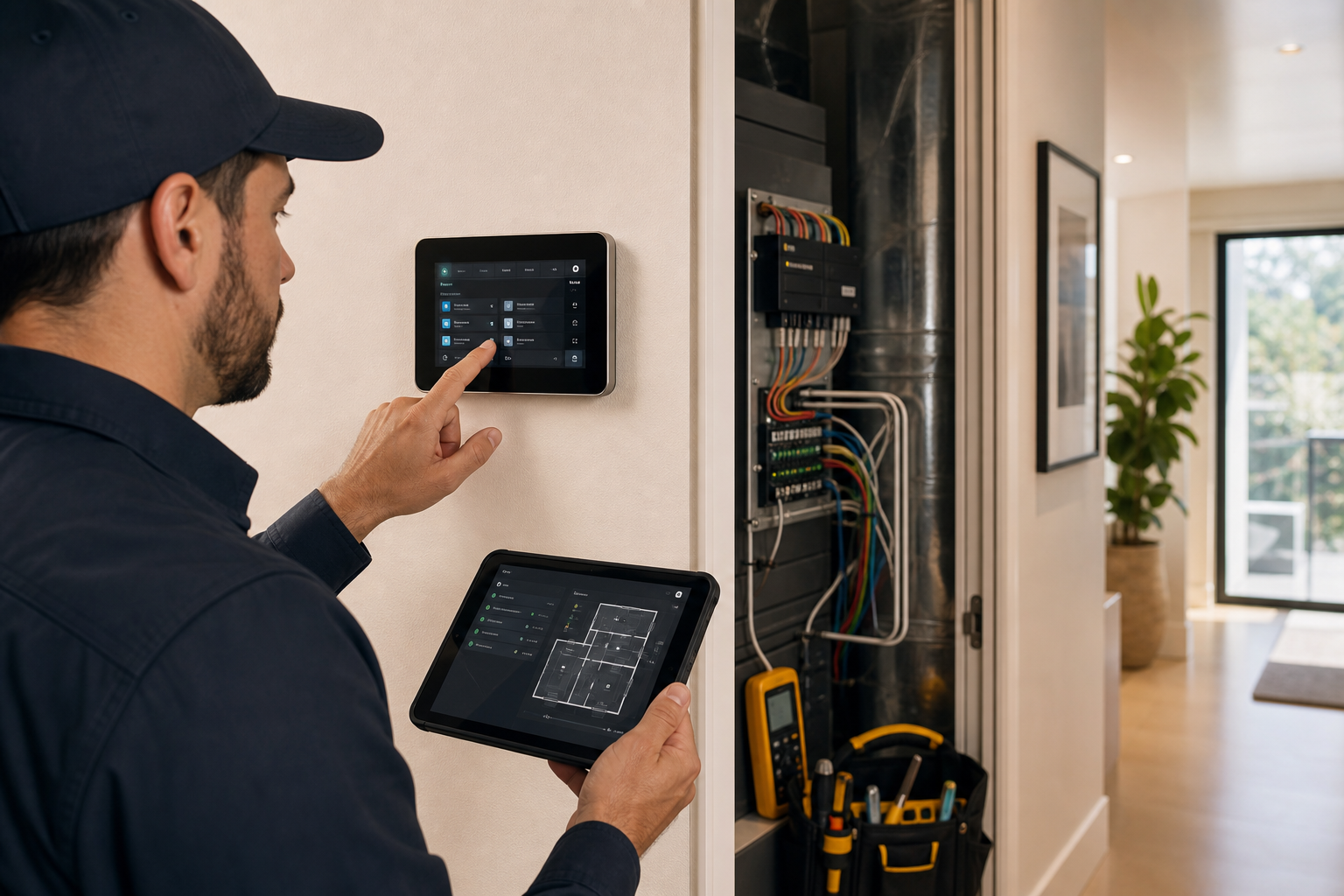
Zoning fails when the contractor sells four zones on a single-stage 4-ton condenser and the bypass damper dumps so much air back into the return that the supply temp drops below 38°F and the coil ices on the smallest call. Real zoning starts with variable-capacity equipment — a Carrier Infinity 24VNA6 with the Infinity controller, a Trane XV18 with the ComfortLink II, or a Bryant Evolution 280B with the Evolution Connex thermostat — because those compressors modulate from roughly 25% to 100% and match the airflow of whichever zone is calling. On a 2,800 sqft Brentwood two-story I will run three zones with a properly sized static-pressure-regulated bypass or a dump zone into the largest common space, and I commission each damper to its full open and full closed position with the system running so the ECM can map the static curve. Smart controls layer on top: ecobee Premium with remote sensors in the master and the upstairs hall, or the manufacturer-native controller when the customer wants the algorithmic staging. Title 24 Part 6 §150.2(b) requires programmable setback, and ASHRAE 62.2-2022 requires that the ventilation rate stays met even when zones close — that means an ERV or a dedicated outside-air damper interlocked with the zone board, not a passive fresh-air run. LADBS does not require a separate permit for low-voltage zone controls under most readings, but if the contractor opens the line-voltage panel for a new transformer or relay then NEC 110.26 working clearance and LADWP load calc still apply. HERS verification is required for refrigerant charge after any system replacement, zoned or not.
Proof checklist for a HVAC Zoning Controls in Koreatown
- zone-by-zone load calculation from Manual J output
- commissioning log of each damper full open and full closed static
- ERV or fresh-air damper interlock wiring diagram with zone board
- manufacturer compatibility statement for thermostat and condenser
- CF2R verification of programmable setback per Title 24
- minimum airflow per zone documented vs equipment minimum CFM
- HERS refrigerant charge report after zone install
- photo of bypass or dump zone configuration with damper position
Long-tail questions homeowners ask about a Koreatown HVAC Zoning Controls
- Carrier Infinity 24VNA6 zoning 3 zone Brentwood install
- Trane XV18 ComfortLink II zoning bypass damper sizing
- Bryant Evolution 280B Connex thermostat 4 zone two story
- ecobee Premium variable speed compatibility AC heat pump
- zoning bypass damper coil icing 38 degrees fix LA
- Title 24 150.2(b) programmable thermostat setback requirement
- ASHRAE 62.2-2022 ventilation zone closed ERV interlock
- static pressure regulated bypass vs dump zone smart zoning
- HERS refrigerant charge verification zoned system Los Angeles
- low voltage zone board transformer NEC 110.26 panel clearance
What belongs in the Koreatown closeout file
- control map
- sensor placement notes
- staging setup
- owner training summary
- damper logic
- sensor placement
- staging settings
- owner training
- short-cycle prevention
Data points used across this site are anchored to LADBS mechanical permits, 2025 California Energy Code, LADWP heat pump rebates, TECH Clean California reservation status, CSLB C-20 permit enforcement, California HERS field verification, ACCA Manual J S and D design, AHRI matched system certificates, ENERGY STAR quality installation, EPA wildfire smoke filtration, ENERGY STAR duct losses. Program details can change, so rebate, permit, and code assumptions should be verified at the time of installation.