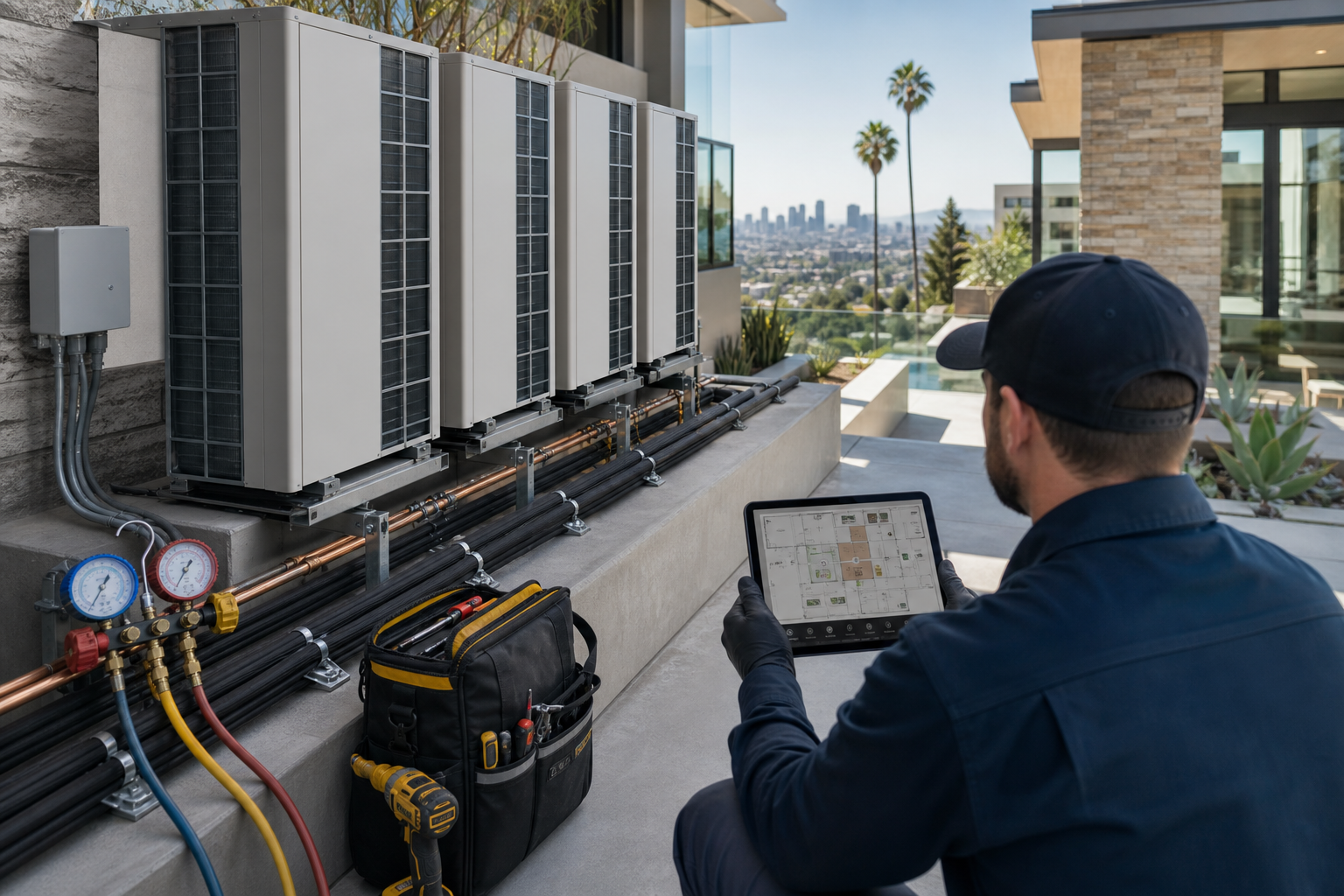
What changes about a VRF system once you cross into Los Angeles
Los Angeles is a stack of microclimates pretending to be one city, and the HVAC scope reflects that the moment you cross from a Bunker Hill high-rise into a 1924 bungalow in Jefferson Park. A retrofit on Wilshire near MacArthur Park inherits cast-iron risers and tenant-by-tenant submetering; a Spanish duplex off Larchmont inherits gravity-furnace chases too narrow for a 14-inch return. Citywide, LADBS pulls mechanical permits separately from electrical, and a heat-pump conversion on a 100-amp service usually triggers a 200A panel upgrade before the condenser even ships. Title 24 Part 6 §150.2(b) governs the alteration path, and HERS verification on duct leakage and refrigerant charge is non-negotiable on replacement work. The basin traps ozone on inversion days, so MERV 13 filtration with a static-pressure budget under 0.5 in. w.c. is the baseline, not the upgrade. Smoke from the 2025 Palisades and Eaton fires pushed half the city into thinking about whole-house filtration the same week the Santa Anas reversed. Every install we hand off includes the Manual J load sheet, the AHRI match certificate, and a commissioning report — because in a market this stratified, the only honest answer to "did it work" is documentation.
The honest framing for a VRF system in Los Angeles is that the contractor inherits the building before they install anything new. Spanish homes, apartments, ADUs, hillside additions, flat roofs, and mixed-age duct systems sets the geometry, marine layer mornings, valley spillover heat, smoke days, and room-by-room load swings sets the load, and old ducts, tight side yards, return-air limits, panel surprises, and LADBS permit sequencing sets the labor sequence. Cali HVAC writes premium vrf and multi-zone installation scopes that name those three inputs in plain text, then negotiates equipment selection against them. The brochure version of the same job tends to skip that step and quote a tonnage.
The first walkthrough for a Los Angeles VRF system is structured around what is measurable today. We pull readings on manufacturer startup, look at zone diversity, and check line-set design against what the equipment will demand. Notes also pick up LADWP and SoCalGas service detail and how Mid-City houses of similar vintage tend to behave once the system is loaded. None of it is opinion; all of it is in the file before the bid is drafted.
Three numbers — tonnage, brand, total — are not a bid; they are a placeholder. A real Los Angeles VRF system scope from Cali HVAC reads through the indoor-outdoor match, the route through old ducts, tight side yards, return-air limits, panel surprises, and LADBS permit sequencing, drainage and electrical assumptions, controls, the photo plan, and the closeout deliverables: zone schedule and line-set record among them. The reason that level of detail is non-negotiable here is simple: citywide installs need a record that separates equipment performance from building constraints.
If you are reading this because you searched a long-tail Los Angeles VRF system phrase, the answer you actually need is the one most pages skip: where this job tends to fail. zones created without realistic load assumptions and line lengths underdocumented are the recurring offenders here, and old ducts, tight side yards, return-air limits, panel surprises, and LADBS permit sequencing amplifies both. Cali HVAC writes those into the proposal as named risks, with the documentation that proves whether they were addressed.
The proof pack is the artifact that survives the contractor relationship. For a VRF system in Los Angeles, it carries zone schedule, line-set record, model photos, filter sizes, control settings, electrical readings, and notes on how the system is expected to behave under marine layer mornings, valley spillover heat, smoke days, and room-by-room load swings. zone schedule, branch-box notes, line-set record, control map, manufacturer startup, service-access photos, and owner training sits in the same file. The homeowner who keeps that file keeps leverage; the one who does not is starting from zero on the next service call.
The reason this site reads installation-first is that replacement is where the homeowner has the least leverage and the most exposure. A bad VRF system in Los Angeles compounds quietly: a rattling cabinet, a duct that whistles, a filter that loads in three weeks, a heat pump that never settles into long cycles. The cure is field work before install day, not warranty calls afterward, and the bid is where that cure gets paid for.
The city also changes the conversation. A Central LA basin home may care about smoke filtration, coastal corrosion, owner-rep documentation, vertical temperature differences, or dense access windows. A single HVAC template cannot handle all of that. The page you are reading is intentionally specific to Los Angeles: Spanish homes, apartments, ADUs, hillside additions, flat roofs, and mixed-age duct systems.
Premium brands do not rescue weak installation. Mitsubishi, Daikin, Bosch, Trane, Carrier, Lennox, Fujitsu — they all assume the contractor will respect airflow, controls, line lengths, filter pressure, and refrigerant procedure. When those are skipped, the badge is no help. The commissioning record is what proves the equipment got a fair chance.
The conditions that shape a Los Angeles vrf system install scope
Local proof angle for Los Angeles vrf system install.
Proof on paper is what separates a finished install from a finished invoice. For Los Angeles, the scope should explain how Spanish homes, apartments, ADUs, hillside additions, flat roofs, and mixed-age duct systems and the access it creates affects equipment placement, airflow, controls, drainage, finish protection, and the final owner record. A city-service page only earns its keep when it gives the homeowner a sharper checklist than a broad Los Angeles service page.
That is why the VRF system conversation starts with the home: Spanish homes, apartments, ADUs, hillside additions, flat roofs, and mixed-age duct systems. The same service can be easy in a flat postwar attic and difficult in a hillside remodel, ADU, condo stack, or coastal roof. The proposal should make those constraints visible before the old system is removed.
What proof a Los Angeles VRF System Install should leave behind
VRF System Install commissioning focus in Los Angeles.
The minimum written scope should describe zone diversity, line-set design, branch boxes, controls, manufacturer startup, then connect each checkpoint to a finished deliverable. If the contractor says the system will be quiet, efficient, smoke-ready, rebate-ready, or better balanced, the closeout file should show which readings, photos, settings, or caveats support that claim.
For Los Angeles searches, long-tail intent usually means the homeowner already knows the service category and wants a local risk answer. Common issues such as line lengths underdocumented, controls confusing owners, zones created without realistic load assumptions should not be discovered after equipment is ordered. They belong in the pre-install notes, with the limits stated plainly when the building will not let the system perform like a brochure.
Stripping the marketing from a Los Angeles VRF System Install estimate
Los Angeles vrf system install planning range before access.
A premium label can raise the ceiling, but it cannot overcome poor installation discipline. The quote that looks expensive may be the better value if it includes model-match evidence, startup values, route photos, filter and control setup, warranty handoff, and clear exclusions. The quote that looks cheaper can become costly when it skips the proof points that decide comfort.
Cali HVAC treats the closeout as part of the product. For a Los Angeles VRF system, that means the homeowner should receive zone schedule, line-set record, startup documentation, owner control map in a format that can be used by a future technician, property manager, warranty desk, rebate reviewer, or owner representative.
What gets archived from a Los Angeles VRF System Install install
Los Angeles vrf system install paperwork context.
LADWP territory makes rebate documentation a front-end question: active electric service, final approved permit, AHRI match, and application timing should be checked before the homeowner treats an incentive as certain. For premium vrf and multi-zone installation, the research-backed document list is zone schedule, branch-box notes, line-set record, control map, manufacturer startup, service-access photos, and owner training. LADWP currently publishes heat pump HVAC rebate tiers up to $2,500 per ton for qualifying systems, but it also ties eligibility to rules such as AHRI match, final approved Building and Safety permit, SEER2/HSPF2 rating, and available program funding. That is why the proposal should never treat a rebate as guaranteed money until the installed system and paperwork are confirmed.
Permitting deserves the same discipline. CSLB C-20 guidance and Los Angeles mechanical-permit references support a simple homeowner question: who is responsible for the permit record, final inspection, and closeout documents? In Los Angeles, that question matters before equipment is ordered because old ducts, tight side yards, return-air limits, panel surprises, and LADBS permit sequencing. A clean VRF system scope should state whether permit fees, HERS or field verification, electrical work, duct sealing, asbestos exclusions, HOA packets, or rebate filing support are included or excluded.
Long-tail questions this Los Angeles vrf system install page should answer
Los Angeles search intent for vrf system install.
The useful searcher is not asking "what is HVAC?" They are asking whether premium homeowners and design teams are comparing multi-zone comfort, VRF/VRV, branch boxes, line-set architecture, controls, and owner-rep documentation. A page built for that intent should answer the decision instead of repeating broad comfort language. For this service, the field answer is load diversity, line lengths, refrigerant calculations, branch-box access, controls, condensate, and whether each zone has a realistic operating range. That gives the homeowner a way to compare proposals using evidence instead of sales adjectives.
VRF is a design and commissioning project, not a bigger mini split; the closeout needs enough detail for a future technician to service it. The best bid should make that tradeoff visible with photos, model numbers, installation constraints, startup readings, and plain-language exclusions. That keeps this page away from doorway behavior because the content is tied to a real Los Angeles installation decision, a specific service, and documentation a homeowner can actually request.
Technical detail: how a VRF System Install actually gets commissioned
VRF on a residence in LA is justified when the building has more than 5 zones, mixed simultaneous heating and cooling demand, or architectural constraints that rule out a conventional split — a 6,200 sqft Bel Air modern with a glass-walled great room facing west and four bedroom suites is the textbook case. I specify Mitsubishi CITY MULTI PURY-EP72YNUMU on a heat-recovery branch with BC controllers, or Daikin VRV LIFE / VRV IV with an RXMQ8AVJU or RXMQ12AVJU outdoor and BSVQ36PVJU branch boxes, depending on whether the project is following Mitsubishi or Daikin commissioning protocols. Line-set pressure testing on VRF is a different animal — nitrogen pressure test to 550 psi held 24 hours, a triple-evacuation vacuum to 500 microns with N2 break between pulls, and refrigerant charge calculated by piping length and additional charge per liter from the engineering manual, not by superheat. AHRI 1230 covers the matched-system rating, NEC 110.26 working clearance and NEC Article 440 disconnect placement apply to the outdoor unit, and ASHRAE Standard 232-2024 commissioning is now the reference for owner closeout. Title 24 Part 6 §150.2(b) and HERS field verification still apply because the system is residential. LADBS pulls a mechanical permit and a separate electrical permit on most VRF jobs because the outdoor disconnect is typically 208V/3-phase or 460V/3-phase service. I commissioned a PURY-EP72YNUMU last year on a Sunset Plaza job where the line-set ran 287 ft from rooftop to lowest indoor unit — that required oil-return logic verification at low-load operation, which is the failure mode that takes out a VRF compressor in year two if the commissioning skipped it.
Proof checklist for a VRF System Install in Los Angeles
- pipework isometric drawing with calculated additional refrigerant charge
- nitrogen pressure test log to 550 psi held 24 hours
- triple-evacuation vacuum log to 500 microns with N2 break
- AHRI 1230 matched-system certificate for the exact VRF combination
- oil-return logic verification at low-load on long pipe runs
- ASHRAE 232-2024 commissioning report signed by CxA
- LADBS mechanical and electrical permit final cards
- manufacturer extended-warranty registration for outdoor and indoor units
Long-tail questions homeowners ask about a Los Angeles VRF System Install
- Mitsubishi CITY MULTI PURY-EP72YNUMU residential install Bel Air
- Daikin VRV LIFE RXMQ8AVJU BSVQ36PVJU branch box
- VRF line set 287 ft oil return commissioning
- VRV IV vs CITY MULTI heat recovery 6 zone home LA
- AHRI 1230 VRF matched system certificate
- VRF nitrogen pressure test 550 psi 24 hour residential
- VRF triple evacuation 500 microns procedure
- Title 24 HERS verification VRF residential Los Angeles
- LADBS permit VRF 460V 3 phase outdoor unit
- ASHRAE 232-2024 commissioning VRF owner closeout
What belongs in the Los Angeles closeout file
- zone schedule
- line-set record
- startup documentation
- owner control map
- zone diversity
- line-set design
- branch boxes
- controls
- manufacturer startup
Data points used across this site are anchored to LADBS mechanical permits, 2025 California Energy Code, LADWP heat pump rebates, TECH Clean California reservation status, CSLB C-20 permit enforcement, California HERS field verification, ACCA Manual J S and D design, AHRI matched system certificates, ENERGY STAR quality installation, EPA wildfire smoke filtration, ENERGY STAR duct losses. Program details can change, so rebate, permit, and code assumptions should be verified at the time of installation.