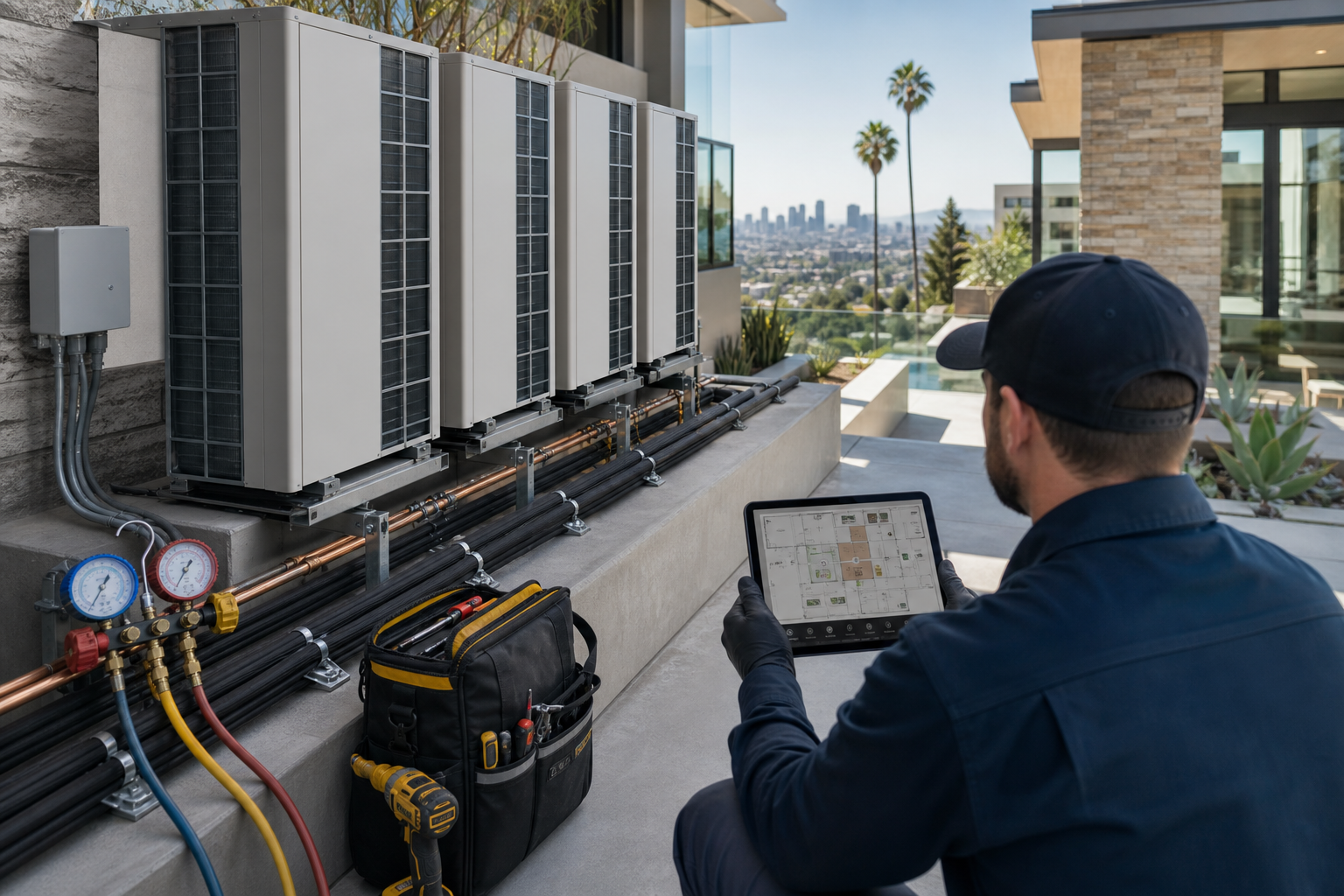
What changes about a VRF system once you cross into Torrance
Torrance is largely 1950s and 1960s tract — Don Wilson, Pacific Coast Properties, and similar postwar builders — laid out on slab with low ceilings, original 60-amp services in too many cases, and gravity furnaces in central hall closets that were never replaced. Old Torrance, around El Prado and Cravens, has the city's oldest stock — 1920s bungalows with floor furnaces and no ducted system at all — where a Mitsubishi multi-zone ductless retrofit with concealed-ducted air handlers in soffits is often the cleanest path. Southwood's slab construction makes ducted retrofits a question of where the supply trunk goes, and the answer is usually the attic with insulated flex on hangers and supply registers in the ceiling. Walteria runs warmer than the Riviera by four to six degrees on a summer afternoon, which changes the design cooling load meaningfully. Torrance Building & Safety is its own jurisdiction and enforces Title 24 §150.2(b) consistently. We size with Manual J, match through AHRI, and verify duct leakage with a HERS rater on every alteration. Commissioning includes a static-pressure reading, refrigerant charge by weigh-in, and a written record handed to the owner before final.
Premium VRF and Multi-Zone Installation in Torrance should be judged by the installed result, not by the equipment box that arrives on the truck. Torrance projects bring single-family homes, townhomes, older gas furnaces, and light commercial edges, marine-inland swings, older ducts, package units, and bedrooms far from returns, and heat pump replacement, duct corrections, furnace-to-heat-pump planning, and permit documentation. That is why Cali HVAC treats every VRF system as a measured system handoff.
Site visits in Torrance are not measurement theater. We check zone diversity, line-set design, and branch boxes first because those are the items that decide whether the new VRF system performs as quoted. The notes also flag the South Bay inland climate pattern, SCE and SoCalGas service, and how nearby Southwood homes typically behave under similar conditions.
If the only number in your bid is tonnage and the only differentiator is the brand sticker, you do not have a real VRF system scope yet. Our quotes for Torrance call out the equipment family, route, drains or electrical scope, photo plan, and the closeout document set. We do that because in Torrance, a useful record identifies whether equipment, duct, return, or filter leakage limited comfort.
Generic VRF system pages dodge the part homeowners actually need: which assumptions can break the install. In Torrance, the local breakers are controls confusing owners and zones created without realistic load assumptions, plus whatever the building hides behind finished walls. A serious bid names those items in writing, with the limits the contractor will not own.
The proof pack is not a courtesy folder; it is the evidence the VRF system was installed as scoped. For a Torrance project the contents include zone schedule, line-set record, model and serial photos, filter dimensions, control settings, and operating notes. zone schedule, branch-box notes, line-set record, control map, manufacturer startup, service-access photos, and owner training also lives there. Six months later, when the original sales contact has moved on, that file is the only thing standing between the homeowner and a guess.
The asymmetry of replacement work is what makes it dangerous. A wrong repair costs a service call; a wrong VRF system costs a decade of energy bills, comfort complaints, and warranty friction. a useful record identifies whether equipment, duct, return, or filter leakage limited comfort. So in Torrance we move slowly through the field walk and the bid, naming controls confusing owners and zones created without realistic load assumptions in writing, so install day becomes execution rather than discovery.
The South Bay inland is not a marketing label; it is a set of conditions the equipment will face every day. marine-inland swings, older ducts, package units, and bedrooms far from returns drives runtime profile, filtration assumptions, and outdoor-unit placement, and single-family homes, townhomes, older gas furnaces, and light commercial edges dictates how the install crew can physically reach the work. A VRF system scope that ignores either is using a generic template, and the building will eventually surface what was skipped.
Brand selection sets the ceiling on what a VRF system can do; commissioning decides how close to that ceiling the homeowner actually gets. Mitsubishi, Daikin, Bosch, Trane, Carrier, and Lennox systems can be installed to perform or installed to disappoint, and the difference is documentation. For Torrance, where heat pump replacement, duct corrections, furnace-to-heat-pump planning, and permit documentation adds friction to every step, that documentation is the deliverable, not the badge.
Local building reality for a Torrance vrf system install
Local proof angle for Torrance vrf system install.
The strongest closeout is readable six months later by a different technician. For Torrance, the scope should explain how the South Bay inland weather pattern affects equipment placement, airflow, controls, drainage, finish protection, and the final owner record. A city-service page only earns its keep when it gives the homeowner a sharper checklist than a broad Los Angeles service page.
That is why the VRF system conversation starts with the home: single-family homes, townhomes, older gas furnaces, and light commercial edges. The same service can be easy in a flat postwar attic and difficult in a hillside remodel, ADU, condo stack, or coastal roof. The proposal should make those constraints visible before the old system is removed.
What the Torrance VRF System Install closeout should record
VRF System Install commissioning focus in Torrance.
The minimum written scope should describe zone diversity, line-set design, branch boxes, controls, manufacturer startup, then connect each checkpoint to a finished deliverable. If the contractor says the system will be quiet, efficient, smoke-ready, rebate-ready, or better balanced, the closeout file should show which readings, photos, settings, or caveats support that claim.
For Torrance searches, long-tail intent usually means the homeowner already knows the service category and wants a local risk answer. Common issues such as line lengths underdocumented, controls confusing owners, zones created without realistic load assumptions should not be discovered after equipment is ordered. They belong in the pre-install notes, with the limits stated plainly when the building will not let the system perform like a brochure.
Comparing Torrance VRF System Install bids on scope rather than logo
Torrance vrf system install planning range before access.
A premium label can raise the ceiling, but it cannot overcome poor installation discipline. The quote that looks expensive may be the better value if it includes model-match evidence, startup values, route photos, filter and control setup, warranty handoff, and clear exclusions. The quote that looks cheaper can become costly when it skips the proof points that decide comfort.
Cali HVAC treats the closeout as part of the product. For a Torrance VRF system, that means the homeowner should receive zone schedule, line-set record, startup documentation, owner control map in a format that can be used by a future technician, property manager, warranty desk, rebate reviewer, or owner representative.
Permits, rebates, and AHRI references on a Torrance VRF System Install
Torrance vrf system install paperwork context.
SCE territory changes the incentive research path, so the page should avoid LADWP-only promises while still documenting permits, AHRI matches, equipment ratings, and closeout proof. For premium vrf and multi-zone installation, the research-backed document list is zone schedule, branch-box notes, line-set record, control map, manufacturer startup, service-access photos, and owner training. LADWP currently publishes heat pump HVAC rebate tiers up to $2,500 per ton for qualifying systems, but it also ties eligibility to rules such as AHRI match, final approved Building and Safety permit, SEER2/HSPF2 rating, and available program funding. That is why the proposal should never treat a rebate as guaranteed money until the installed system and paperwork are confirmed.
Permitting deserves the same discipline. CSLB C-20 guidance and Los Angeles mechanical-permit references support a simple homeowner question: who is responsible for the permit record, final inspection, and closeout documents? In Torrance, that question matters before equipment is ordered because heat pump replacement, duct corrections, furnace-to-heat-pump planning, and permit documentation. A clean VRF system scope should state whether permit fees, HERS or field verification, electrical work, duct sealing, asbestos exclusions, HOA packets, or rebate filing support are included or excluded.
The unanswered Torrance vrf system install questions worth addressing on the page
Torrance search intent for vrf system install.
The useful searcher is not asking "what is HVAC?" They are asking whether premium homeowners and design teams are comparing multi-zone comfort, VRF/VRV, branch boxes, line-set architecture, controls, and owner-rep documentation. A page built for that intent should answer the decision instead of repeating broad comfort language. For this service, the field answer is load diversity, line lengths, refrigerant calculations, branch-box access, controls, condensate, and whether each zone has a realistic operating range. That gives the homeowner a way to compare proposals using evidence instead of sales adjectives.
VRF is a design and commissioning project, not a bigger mini split; the closeout needs enough detail for a future technician to service it. The best bid should make that tradeoff visible with photos, model numbers, installation constraints, startup readings, and plain-language exclusions. That keeps this page away from doorway behavior because the content is tied to a real Torrance installation decision, a specific service, and documentation a homeowner can actually request.
Technical detail: how a VRF System Install actually gets commissioned
VRF on a residence in LA is justified when the building has more than 5 zones, mixed simultaneous heating and cooling demand, or architectural constraints that rule out a conventional split — a 6,200 sqft Bel Air modern with a glass-walled great room facing west and four bedroom suites is the textbook case. I specify Mitsubishi CITY MULTI PURY-EP72YNUMU on a heat-recovery branch with BC controllers, or Daikin VRV LIFE / VRV IV with an RXMQ8AVJU or RXMQ12AVJU outdoor and BSVQ36PVJU branch boxes, depending on whether the project is following Mitsubishi or Daikin commissioning protocols. Line-set pressure testing on VRF is a different animal — nitrogen pressure test to 550 psi held 24 hours, a triple-evacuation vacuum to 500 microns with N2 break between pulls, and refrigerant charge calculated by piping length and additional charge per liter from the engineering manual, not by superheat. AHRI 1230 covers the matched-system rating, NEC 110.26 working clearance and NEC Article 440 disconnect placement apply to the outdoor unit, and ASHRAE Standard 232-2024 commissioning is now the reference for owner closeout. Title 24 Part 6 §150.2(b) and HERS field verification still apply because the system is residential. LADBS pulls a mechanical permit and a separate electrical permit on most VRF jobs because the outdoor disconnect is typically 208V/3-phase or 460V/3-phase service. I commissioned a PURY-EP72YNUMU last year on a Sunset Plaza job where the line-set ran 287 ft from rooftop to lowest indoor unit — that required oil-return logic verification at low-load operation, which is the failure mode that takes out a VRF compressor in year two if the commissioning skipped it.
Proof checklist for a VRF System Install in Torrance
- pipework isometric drawing with calculated additional refrigerant charge
- nitrogen pressure test log to 550 psi held 24 hours
- triple-evacuation vacuum log to 500 microns with N2 break
- AHRI 1230 matched-system certificate for the exact VRF combination
- oil-return logic verification at low-load on long pipe runs
- ASHRAE 232-2024 commissioning report signed by CxA
- LADBS mechanical and electrical permit final cards
- manufacturer extended-warranty registration for outdoor and indoor units
Long-tail questions homeowners ask about a Torrance VRF System Install
- Mitsubishi CITY MULTI PURY-EP72YNUMU residential install Bel Air
- Daikin VRV LIFE RXMQ8AVJU BSVQ36PVJU branch box
- VRF line set 287 ft oil return commissioning
- VRV IV vs CITY MULTI heat recovery 6 zone home LA
- AHRI 1230 VRF matched system certificate
- VRF nitrogen pressure test 550 psi 24 hour residential
- VRF triple evacuation 500 microns procedure
- Title 24 HERS verification VRF residential Los Angeles
- LADBS permit VRF 460V 3 phase outdoor unit
- ASHRAE 232-2024 commissioning VRF owner closeout
What belongs in the Torrance closeout file
- zone schedule
- line-set record
- startup documentation
- owner control map
- zone diversity
- line-set design
- branch boxes
- controls
- manufacturer startup
Data points used across this site are anchored to LADBS mechanical permits, 2025 California Energy Code, LADWP heat pump rebates, TECH Clean California reservation status, CSLB C-20 permit enforcement, California HERS field verification, ACCA Manual J S and D design, AHRI matched system certificates, ENERGY STAR quality installation, EPA wildfire smoke filtration, ENERGY STAR duct losses. Program details can change, so rebate, permit, and code assumptions should be verified at the time of installation.