What changes about a ductwork redesign once you cross into Venice
Venice rewards careful mechanical thinking because almost nothing about the building stock is standard. Abbot Kinney's converted bungalows often hide additions stacked on additions, with three different roof heights and no continuous attic; the Venice Canals' walk-streets prohibit any equipment that has to come in by truck longer than a panel van, so a Daikin or Mitsubishi mini-split with a 5/8-inch line set threaded along an exterior wall is sometimes the only path. Oakwood's small lots and zero side-yard setbacks force outdoor units onto roofs or into front-yard enclosures, and the city's 50 dBA nighttime exterior noise limit forces a sound-data sheet review before placement. The marine layer keeps Venice cooler than Mar Vista by four to six degrees most summer afternoons, which makes oversizing a real risk; we have replaced too many 4-ton single-stage condensers that ran for ninety seconds and shut down. Variable-capacity inverter equipment running between 25 and 100 percent capacity with Kumo Cloud control solves the latent load on a 65-degree foggy July morning. Every install closes with a documented refrigerant weigh-in, a Manual J on file, and a HERS-verified duct leakage test under 5 percent.
The ductwork redesign conversation in Venice works better when it begins with what the building is, not what the catalog offers. narrow lots, modern boxes, bungalows, mixed-use spaces, and rooftop equipment and salt air, tight setbacks, humidity swings, and neighbor-sensitive equipment are not abstractions on this side of the foothills; they decide whether a system runs long efficient cycles or fights the house. Cali HVAC reads those conditions first, then writes a scope that respects quiet ductless placement, roof access, condensate routing, and compact filter options before any equipment family is named.
Site visits exist to remove guesses, not to create momentum. For a Venice ductwork redesign we measure leak priorities, photograph filter pressure drop, check the LADWP and SoCalGas service entry, and write down which Coastal Westside climate behaviors the new system will be answering. The file produced on that visit is the document the bid is built on; if a contractor cannot produce one, the bid is a guess wearing a price tag.
A conventional bid can hide too much behind a tonnage number. Our ductwork redesign recommendation names the equipment family, the indoor and outdoor match, the route, the drainage or electrical assumptions, and the owner handoff. The closeout file is designed to make a future service technician, property manager, or homeowner understand why the system was installed the way it was. That matters in Venice because documentation should show sound, drain, and service access details before a tight install is hidden.
Searches like "Venice ductwork redesign" deserve a real answer, not a coupon. The honest answer in Venice usually involves at least one of these risks: hot rooms treated with oversized condensers, or new equipment attached to bad ducts. The proposal should call those out instead of pretending the install is identical to a flat-lot suburban tract.
Closeout is where the ductwork redesign stops being a sales conversation and becomes a documented installed system. Expect duct priority list, return correction notes, airflow readings, before-and-after photos in the file, plus photos, filter dimensions, control settings, and operating notes. If the closeout for an inverter or heat pump system does not address runtime profile, the file is incomplete.
Replacement work is uniquely unforgiving. Once the old ductwork redesign target is removed and the wall is closed, fixing a sizing or airflow mistake is expensive. So in Venice we move slowly on the front end: load assumptions, return-air check, attic or roof access, line or duct route — all settled before the crew shows up. The reward is an install day with no surprises.
Geography is not decorative on these pages. Venice sits inside the Coastal Westside, where salt air, tight setbacks, humidity swings, and neighbor-sensitive equipment change what the system has to do hour by hour. narrow lots, modern boxes, bungalows, mixed-use spaces, and rooftop equipment adds its own constraints on labor and routing. A ductwork redesign bid that does not adjust for those inputs is borrowing assumptions from a different city, and the homeowner pays for that borrowing in the first season.
Premium equipment can outperform a budget unit, but only when the install does not drag it back to average. Mitsubishi, Daikin, Bosch, Trane, Carrier, and Lennox systems all have well-documented failure modes that originate in installation, not engineering. For a Venice ductwork redesign, leak priorities and filter pressure drop are how those failure modes get caught and prevented before the homeowner is the one finding them.
Venice field conditions that change a ductwork redesign
Local proof angle for Venice ductwork redesign.
A useful proposal names the condition, the decision, and the verification method. For Venice, the scope should explain how Coastal Westside airflow patterns into Abbot Kinney, Venice Canals, Oakwood affects equipment placement, airflow, controls, drainage, finish protection, and the final owner record. A city-service page only earns its keep when it gives the homeowner a sharper checklist than a broad Los Angeles service page.
That is why the ductwork redesign conversation starts with the home: narrow lots, modern boxes, bungalows, mixed-use spaces, and rooftop equipment. The same service can be easy in a flat postwar attic and difficult in a hillside remodel, ADU, condo stack, or coastal roof. The proposal should make those constraints visible before the old system is removed.
Commissioning checklist for a Venice ductwork redesign
Ductwork Redesign commissioning focus in Venice.
The minimum written scope should describe static pressure, return path, supply balance, leak priorities, filter pressure drop, then connect each checkpoint to a finished deliverable. If the contractor says the system will be quiet, efficient, smoke-ready, rebate-ready, or better balanced, the closeout file should show which readings, photos, settings, or caveats support that claim.
For Venice searches, long-tail intent usually means the homeowner already knows the service category and wants a local risk answer. Common issues such as new equipment attached to bad ducts, dense filters starving blowers, hot rooms treated with oversized condensers should not be discovered after equipment is ordered. They belong in the pre-install notes, with the limits stated plainly when the building will not let the system perform like a brochure.
Filtering Venice ductwork redesign quotes by proof, not branding
Venice ductwork redesign planning range before access.
A premium label can raise the ceiling, but it cannot overcome poor installation discipline. The quote that looks expensive may be the better value if it includes model-match evidence, startup values, route photos, filter and control setup, warranty handoff, and clear exclusions. The quote that looks cheaper can become costly when it skips the proof points that decide comfort.
Cali HVAC treats the closeout as part of the product. For a Venice ductwork redesign, that means the homeowner should receive duct priority list, return correction notes, airflow readings, before-and-after photos in a format that can be used by a future technician, property manager, warranty desk, rebate reviewer, or owner representative.
What documents survive the Venice ductwork redesign closeout
Venice ductwork redesign paperwork context.
LADWP territory makes rebate documentation a front-end question: active electric service, final approved permit, AHRI match, and application timing should be checked before the homeowner treats an incentive as certain. For ductwork redesign and airflow correction, the research-backed document list is static pressure readings, return correction notes, duct leakage priorities, filter pressure-drop notes, and before-and-after photos. LADWP currently publishes heat pump HVAC rebate tiers up to $2,500 per ton for qualifying systems, but it also ties eligibility to rules such as AHRI match, final approved Building and Safety permit, SEER2/HSPF2 rating, and available program funding. That is why the proposal should never treat a rebate as guaranteed money until the installed system and paperwork are confirmed.
Permitting deserves the same discipline. CSLB C-20 guidance and Los Angeles mechanical-permit references support a simple homeowner question: who is responsible for the permit record, final inspection, and closeout documents? In Venice, that question matters before equipment is ordered because quiet ductless placement, roof access, condensate routing, and compact filter options. A clean ductwork redesign scope should state whether permit fees, HERS or field verification, electrical work, duct sealing, asbestos exclusions, HOA packets, or rebate filing support are included or excluded.
Questions a Venice buyer types before approving a ductwork redesign
Venice search intent for ductwork redesign.
The useful searcher is not asking "what is HVAC?" They are asking whether the searcher usually has hot rooms, loud returns, dust, short cycling, or a new system that never performed like the proposal promised. A page built for that intent should answer the decision instead of repeating broad comfort language. For this service, the field answer is Manual D-style duct geometry, return path, attic duct insulation, filter cabinet bypass, and whether equipment capacity exceeds duct capacity. That gives the homeowner a way to compare proposals using evidence instead of sales adjectives.
Duct repair can beat equipment replacement when the system is starved for air; the proof is in readings, not comfort adjectives. The best bid should make that tradeoff visible with photos, model numbers, installation constraints, startup readings, and plain-language exclusions. That keeps this page away from doorway behavior because the content is tied to a real Venice installation decision, a specific service, and documentation a homeowner can actually request.
Technical detail: how a Ductwork Redesign actually gets commissioned
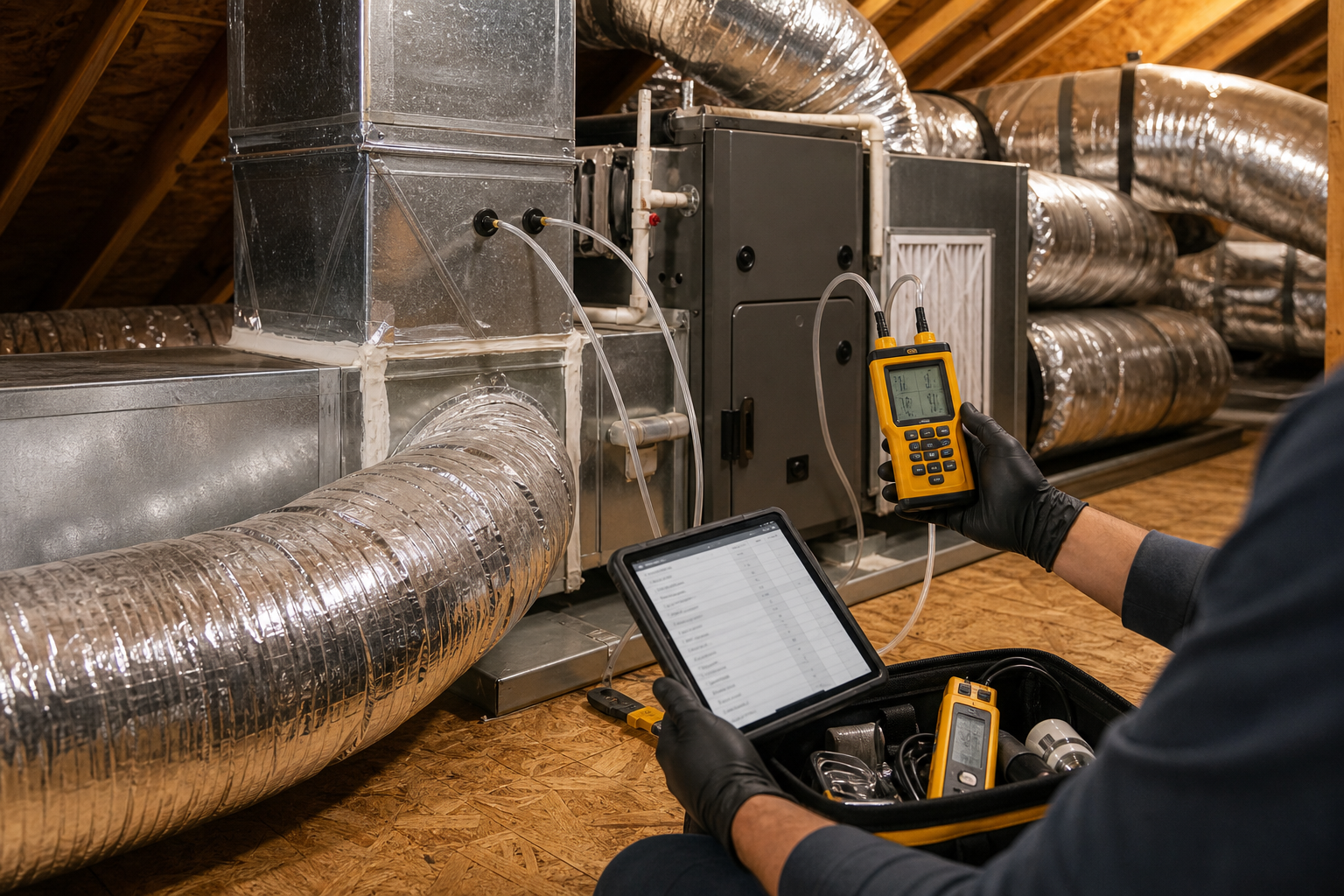
Ductwork is the single biggest reason new equipment underperforms in this market, and I will not warranty a new condenser onto an old duct system without a static pressure profile and a Manual D redesign on paper. The pattern I see in 1960s Valley tract homes is a 14-inch round trunk feeding eight 6-inch flex runs that were already marginal at 1,200 CFM — drop a Bryant Preferred 226A or any modern blower onto that and external static climbs from 0.42 to 0.78 in.w.c. the moment the homeowner installs a 1-inch MERV 16 filter, then the ECM ramps to 100% trying to hit airflow and the homeowner calls about noise at the supply registers. The fix is a Manual D rebuild with proper trunk sizing, hard pipe in the first 8 ft off the air handler, R-8 flex on the branch runs, and a 4-inch deep media cabinet sized for 500 fpm face velocity so a MERV 13 or MERV 16 cartridge does not choke the system. Every redesign gets a HERS duct leakage test per Title 24 §150.0(m) — ≤ 5% on a tested system, ≤ 10% if a portion stays in conditioned space — and pressure-balanced returns in every bedroom over 100 sqft per ASHRAE 62.2-2022. I document blower CFM commissioned to nameplate (typically 800 to 1,600 CFM depending on tonnage), final external static at or below 0.5 in.w.c., and supply temperature split within manufacturer spec. LADBS requires the mechanical permit when more than 40 linear ft of duct is replaced.
Proof checklist for a Ductwork Redesign in Venice
- pre-redesign static pressure measurement and post-redesign measurement
- Manual D plan showing trunk sizing, branch CFM, and equivalent length
- HERS duct leakage report ≤ 5% with CF2R-MCH-25-H form
- photo of 4-inch media filter cabinet and MERV rating sticker
- blower commissioning sheet with CFM, ESP, and temperature split
- pressure-balanced return verification for each bedroom
- R-value tag photo on installed flex duct (R-8 minimum in attic)
- LADBS mechanical permit final signature when over 40 ft replaced
Long-tail questions homeowners ask about a Venice Ductwork Redesign
- duct redesign cost 1960s Valley tract home Manual D
- static pressure 0.78 in wc MERV 16 filter fix LA
- flex duct R-8 vs hard pipe trunk replacement Sherman Oaks
- HERS duct leakage test 5 percent Title 24 cost
- blower CFM commissioning 1600 ECM variable speed Carrier
- return air bedroom pressure balance ASHRAE 62.2-2022
- 4 inch media filter cabinet MERV 13 face velocity 500 fpm
- duct redesign LADBS permit threshold 40 linear feet
- external static pressure target 0.5 in wc residential ECM blower
- duct leakage test cost San Fernando Valley HERS rater
What belongs in the Venice closeout file
- duct priority list
- return correction notes
- airflow readings
- before-and-after photos
- static pressure
- return path
- supply balance
- leak priorities
- filter pressure drop
Data points used across this site are anchored to LADBS mechanical permits, 2025 California Energy Code, LADWP heat pump rebates, TECH Clean California reservation status, CSLB C-20 permit enforcement, California HERS field verification, ACCA Manual J S and D design, AHRI matched system certificates, ENERGY STAR quality installation, EPA wildfire smoke filtration, ENERGY STAR duct losses. Program details can change, so rebate, permit, and code assumptions should be verified at the time of installation.